
What Role Will Frontier Models Play in Robotics?
A robot needs to do two things. It needs to decide what to do, and it needs to physically do it.
Today, both are hard. A robot must understand a request, find its way around a space, grasp unfamiliar objects, and recover when something goes wrong. Robotic foundation models (RFMs) are making rapid progress on the physical side of that problem.
But I’ve been wondering how the work will be divided as robots improve.
Suppose walking, grasping, picking, placing, and opening a drawer become reliable skills available across many robots. At that point, the question shifts from “Can the robot pick up this object?” to “What should it do next?” It has to understand the goal, remember where things are, sequence actions, notice mistakes, and revise its plan.
How much of that higher-order work will RFMs do? How much will frontier models from companies like OpenAI and Anthropic do? And how will the two layers improve each other?
A recent Stanford project called HomeBody makes the question tangible. The researchers put a frontier model, GPT Astra, in charge of a humanoid in a kitchen it had not seen before. The robot explored the room, built a spatial memory, and then carried out tasks such as gathering coffee bags, throwing away cartons, and retrieving medicine from a drawer.
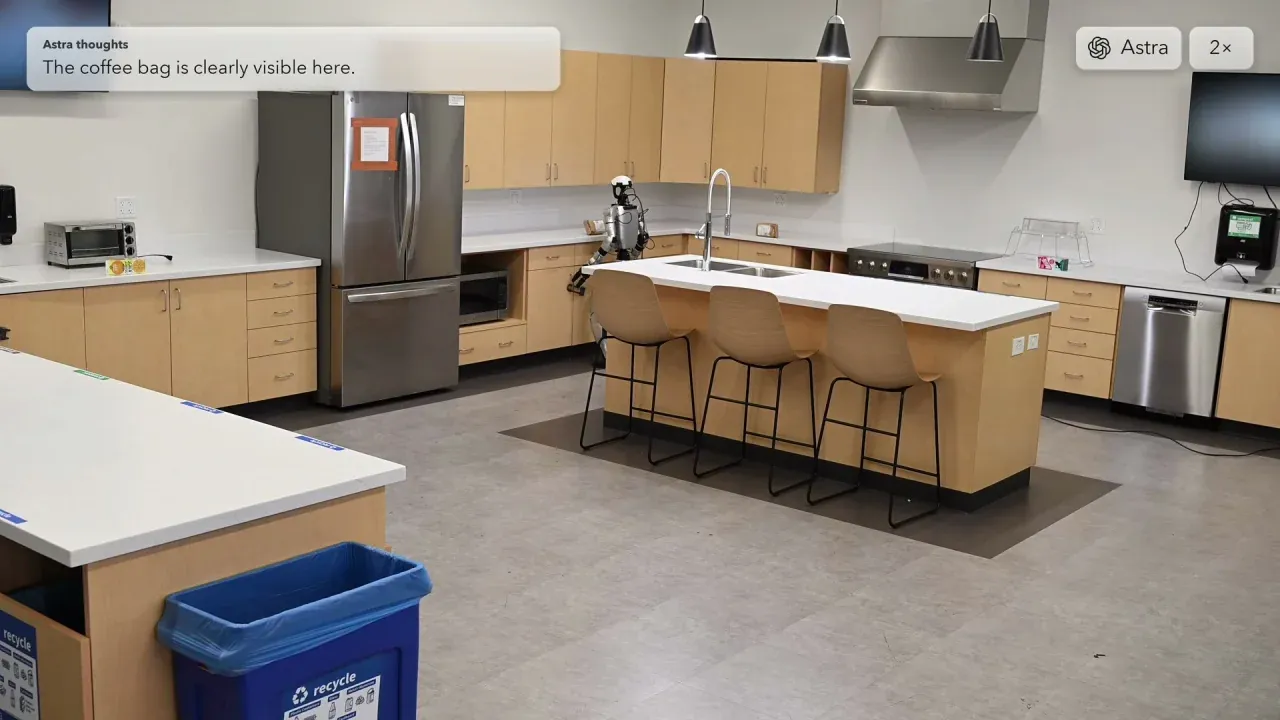
Still from Stanford’s kitchen cleanup demonstration.
Astra did not directly control every joint movement. It chose from a set of skills—navigate, pick, place, open a drawer—and specified targets for them. The robotics system handled perception, motion planning, balance, and local retries. When a skill finished or failed, Astra decided what to do next. Stanford’s architecture diagram shows that division clearly.
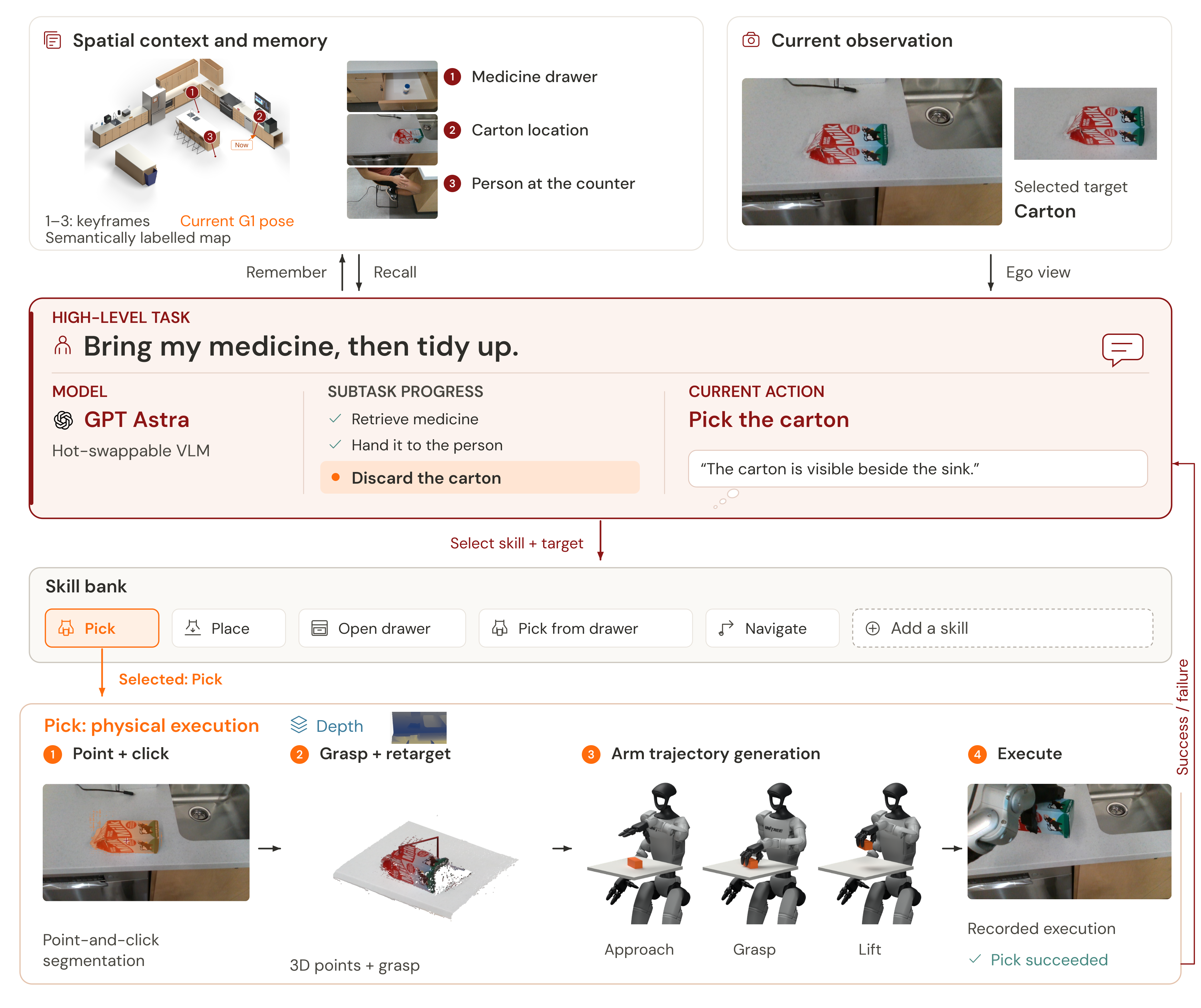
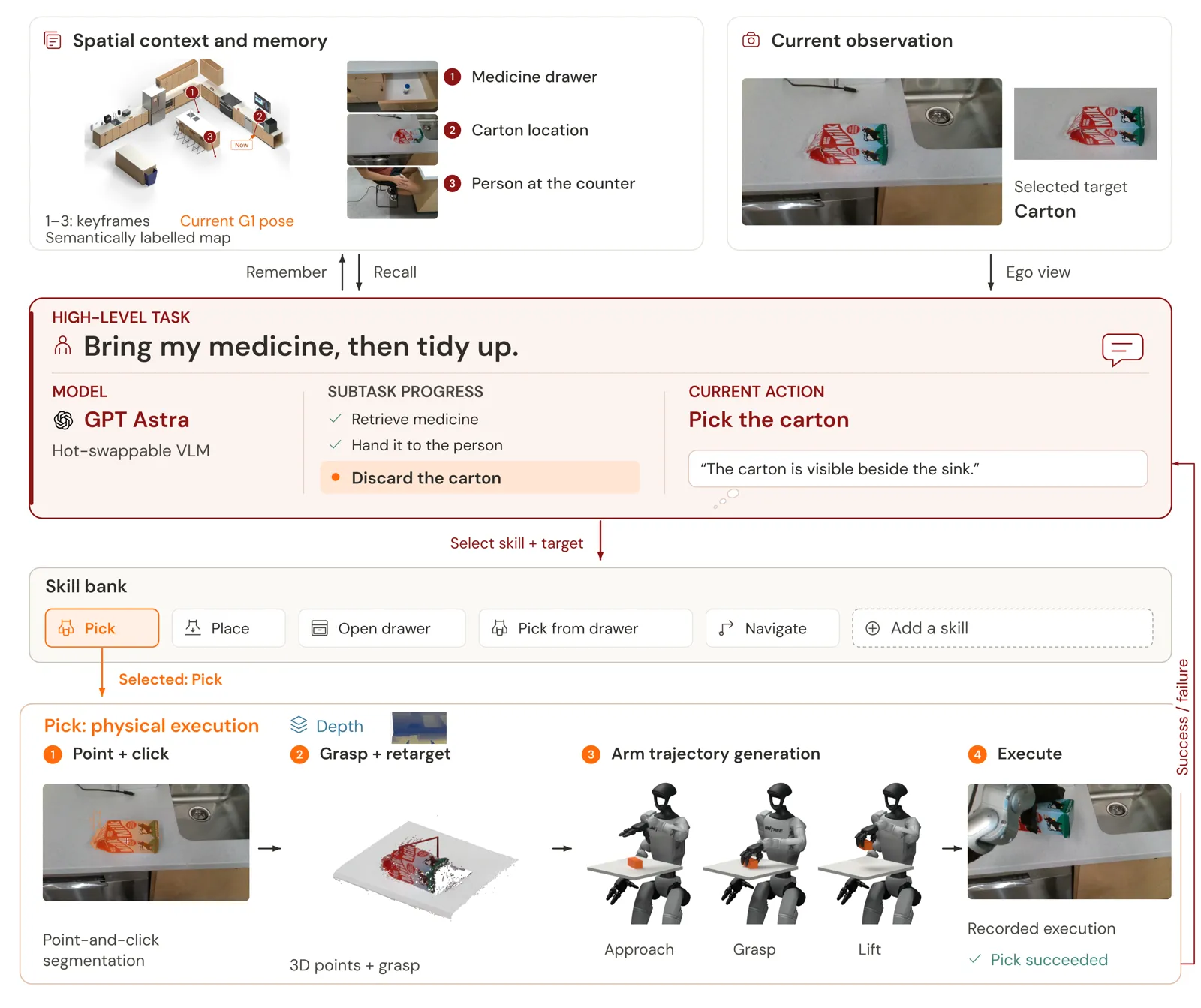
HomeBody architecture: Astra selects a skill and target; the robotics stack executes and returns feedback. Source: Stanford Movement Lab.
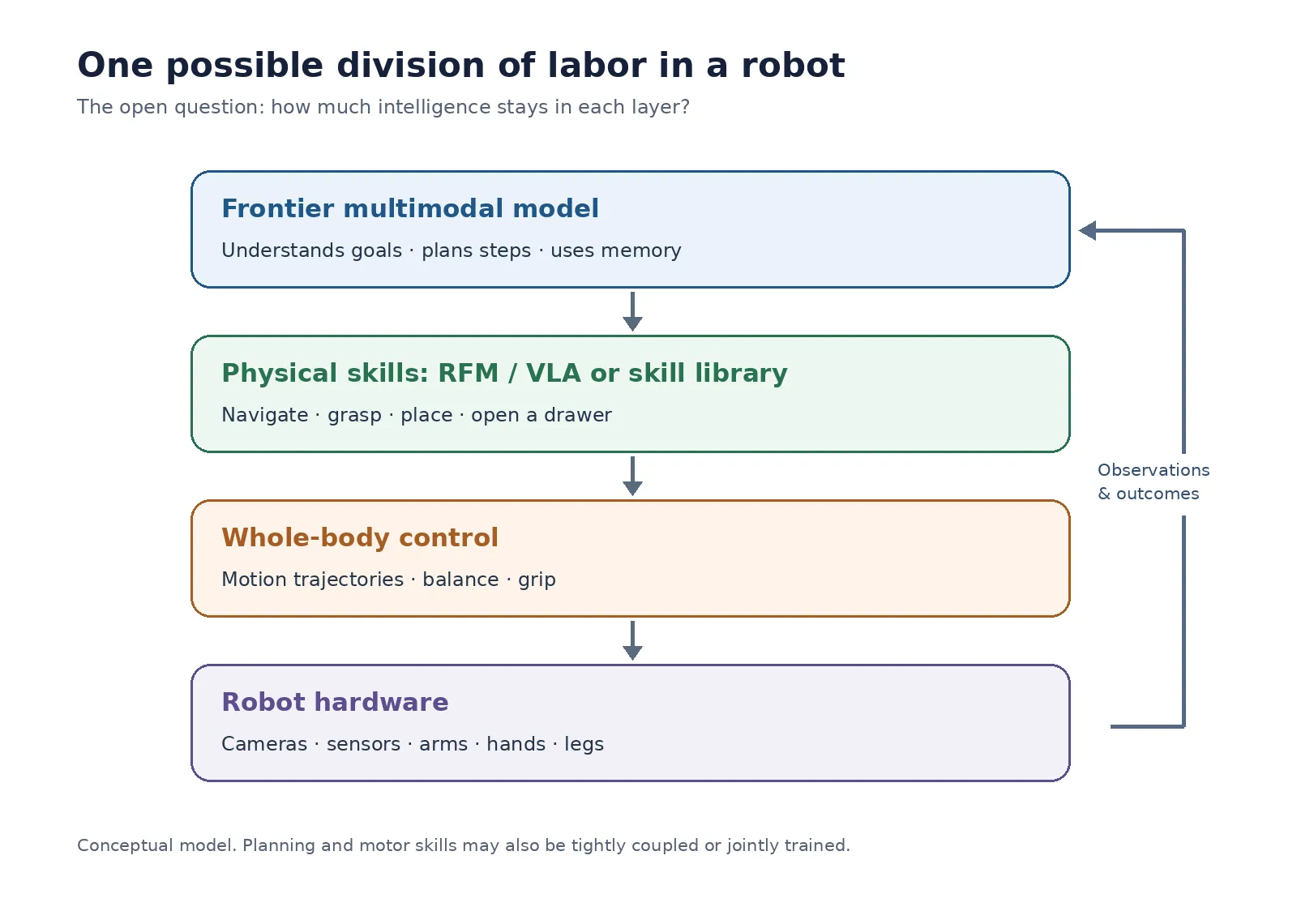
That is an intriguing division of labor. The physical skills are essential, while a general frontier model plans how to use them.
There is a loose parallel in human work. The person performing a physical task is generally paid less than the person deciding how to organize that work. An assembly-line worker executes a step; supervisors and engineers decide how the line should run and what to change when it doesn’t. Wages are not a direct measure of where company value will accrue, and physical labor is a huge market in aggregate. Still, the analogy raises a useful question: if execution becomes widely available, where will the scarce intelligence sit?
One possibility is that increasingly capable frontier models take on more of the planning. Better reasoning might let a robot handle longer, less precisely specified jobs, even when its repertoire of physical skills stays the same. In that scenario, improvements in frontier models could account for a growing share of the value a customer sees.
This also suggests we may be underestimating the end market for frontier AI. We usually size it against knowledge work—coding, analysis, customer support, and the like. But if frontier models become the layer that plans and coordinates physical work, their market could include some of the highest-value judgment in factories, warehouses, and other physical settings. They would not need to capture the entire labor bill for that to be a very large opportunity.
Another possibility is that planning and execution cannot be separated so neatly. To decide whether a cup can be grasped, a part will fit, or a drawer will open, a model may need knowledge learned from physical attempts. The data gathered while robots operate could be crucial to both physical control and higher-order decisions. Frontier models might also make RFMs more capable by giving them better goals and subtasks, rather than displacing their intelligence.
And the bar for reliable execution may be much higher than a demo suggests. A robot that succeeds 95% of the time can be impressive on video and unusable over a full shift. If reaching dependable performance requires years of embodied learning, physical skills will remain a deep source of differentiation. Even HomeBody relies on a pretrained whole-body control policy to coordinate walking and upper-body movement.
HomeBody does not settle any of this. Its skill library required serious robotics work, and the researchers describe retries, setup costs, latency, and hardware limits. It shows that a frontier model can coordinate meaningful physical tasks in a new space. It does not show that the underlying skills are easy to build or that the system is ready to run unattended.
But it points to a question I’ll be watching: as robots master more physical skills, how will higher-order planning be split between frontier models and RFMs?
The answer may not be one model replacing the other. The more interesting outcome could be a tight feedback loop: frontier models get better at directing robots, while RFMs learn from physical experience and expand what those directions can achieve. Where that boundary settles will shape how value is created and captured in robotics.
This post is also on Substack, where you can comment.