
What 32 Founders from Google's AI Teams Have in Common
How Google's AI mafia is shaping tech.
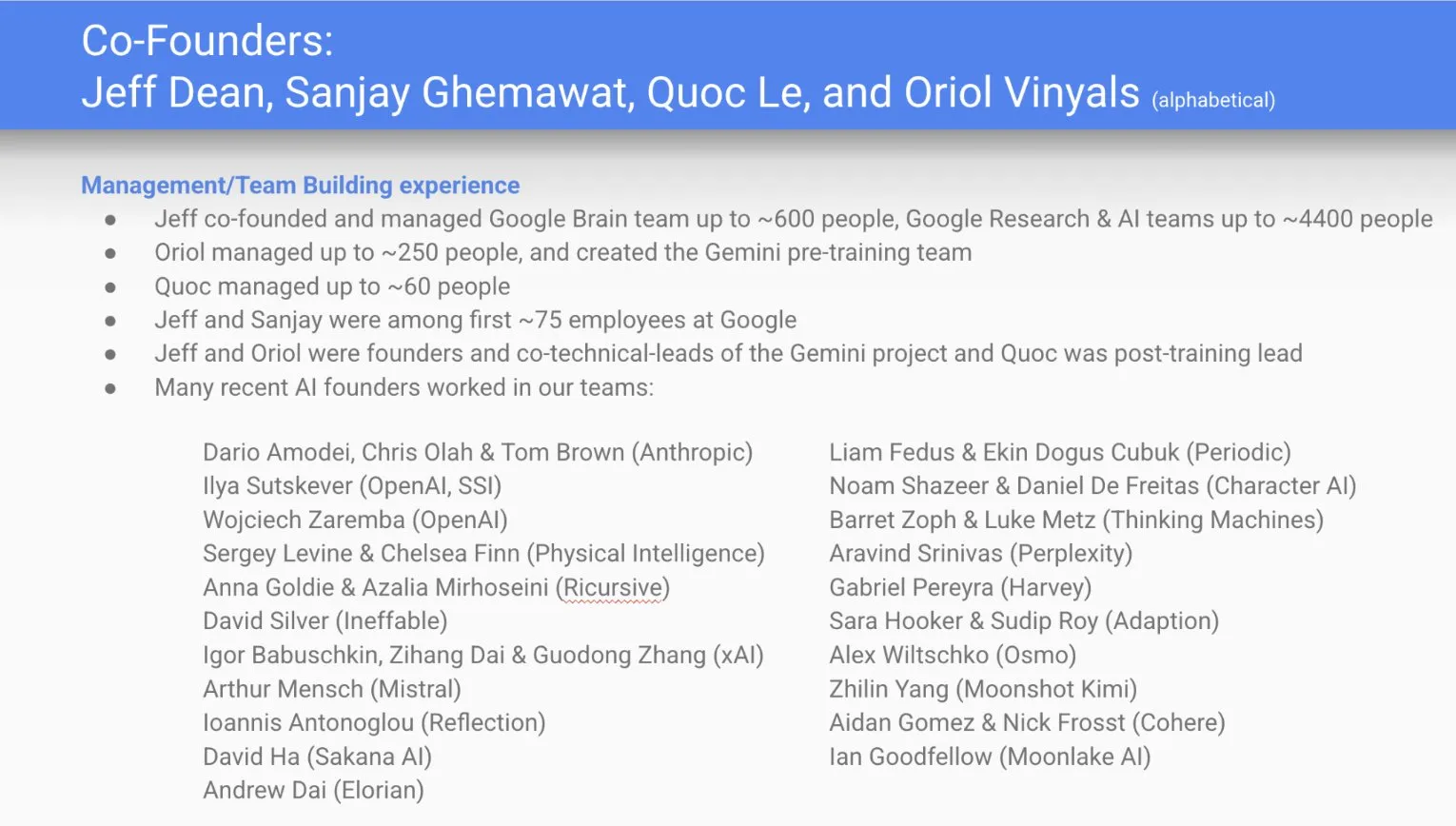
The slide Jeff Dean shared, listing people who worked in the Discovery Loop founders’ teams.
Every once in a while, a company becomes the starting point for a much larger technology wave. Often, the influence comes from a particular group within it.
Fairchild Semiconductor is one example. Its alumni helped build the semiconductor industry around it. PayPal is another. People who worked together there went on to start companies across the internet economy. We call this the “mafia effect,” though the interesting question is why it happens so rarely.
A slide Jeff Dean shared recently made me think we may be seeing another example in AI. It lists 32 people who worked in the teams of Jeff Dean, Sanjay Ghemawat, Quoc Le and Oriol Vinyals. Many later founded companies, including Anthropic, OpenAI, Mistral, Perplexity, Cohere and Physical Intelligence.
I wanted to understand this group better, so I built a profile of each person. Each profile covers the person’s education and Google team. It also covers where they went next and what they founded. The profiles are in a companion app where you can filter and chart the group yourself. Each chart below links to the same view in the app.
What the companies are worth
31 of the 32 people are confirmed founders. Together they founded 21 companies. The 20 companies with a known value add up to about $3.24 trillion as of November 27, 2026.
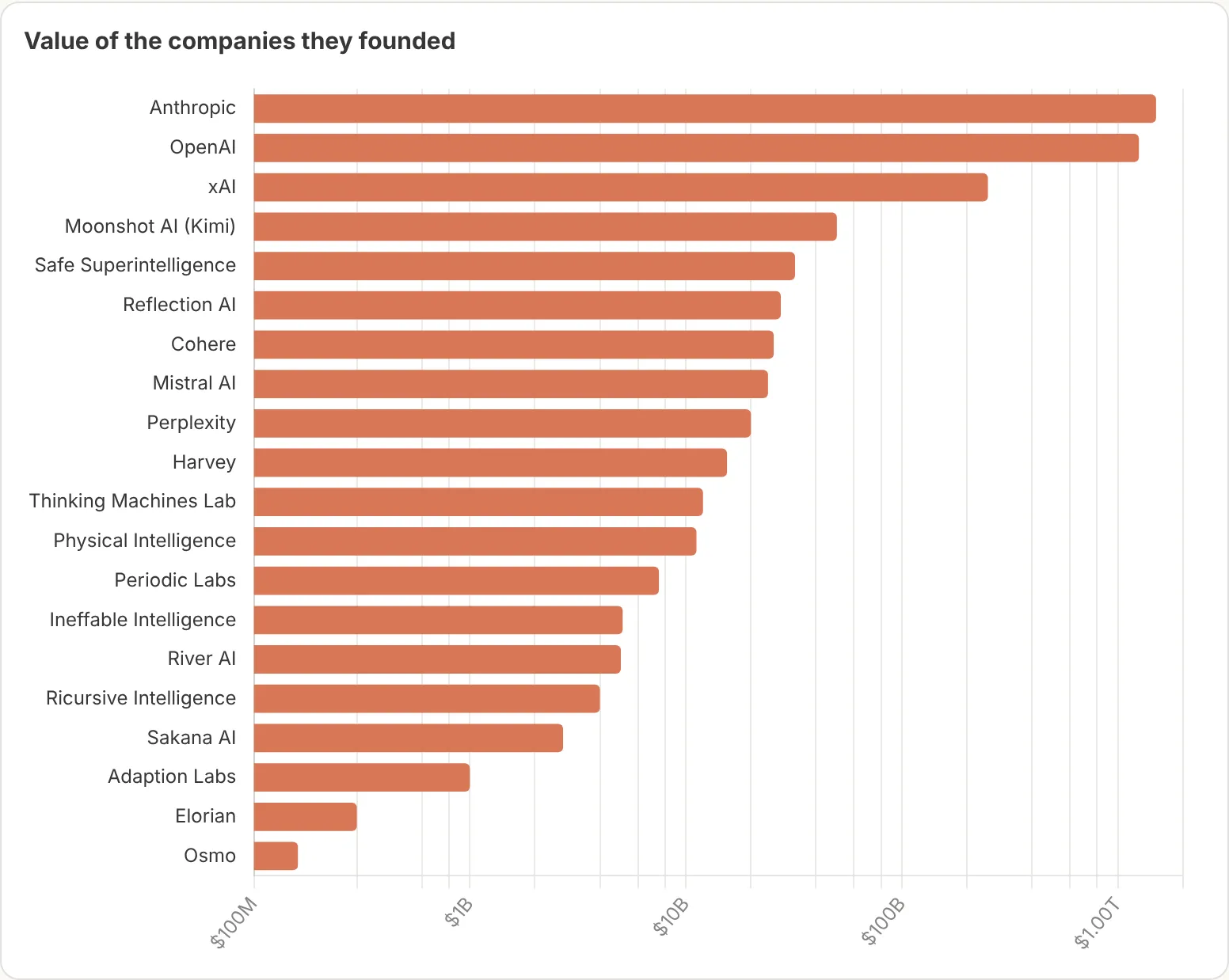
The chart shows the latest value of each company on a log scale. Open this chart in the app, or see the basis and source for each value on the Companies tab.
That number needs context. Three companies make up about 92% of it. Anthropic is valued at $1.5 trillion at its IPO price. OpenAI is valued at $1.25 trillion at the first close of its current round. xAI was valued at $250 billion when it merged with SpaceX. The other 17 companies add up to about $243 billion.
The range of companies may tell us more than the total. Most of the founders build frontier models, but not all of them. Sergey Levine and Chelsea Finn co-founded Physical Intelligence, which builds models for robots. Anna Goldie and Azalia Mirhoseini co-founded Ricursive Intelligence to use AI in chip design. Liam Fedus and Ekin Dogus Cubuk started Periodic Labs to discover new materials. Gabriel Pereyra co-founded Harvey, which builds AI for lawyers.
What they have in common
With the profiles in one place, a few patterns stand out.
Most joined Google in the same few years. 18 of the 32 joined Google from 2015 to 2017, while Google Brain was expanding and starting its residency program. Most then founded their company straight out of Google. 20 of the 31 founders started their company within a year of leaving.
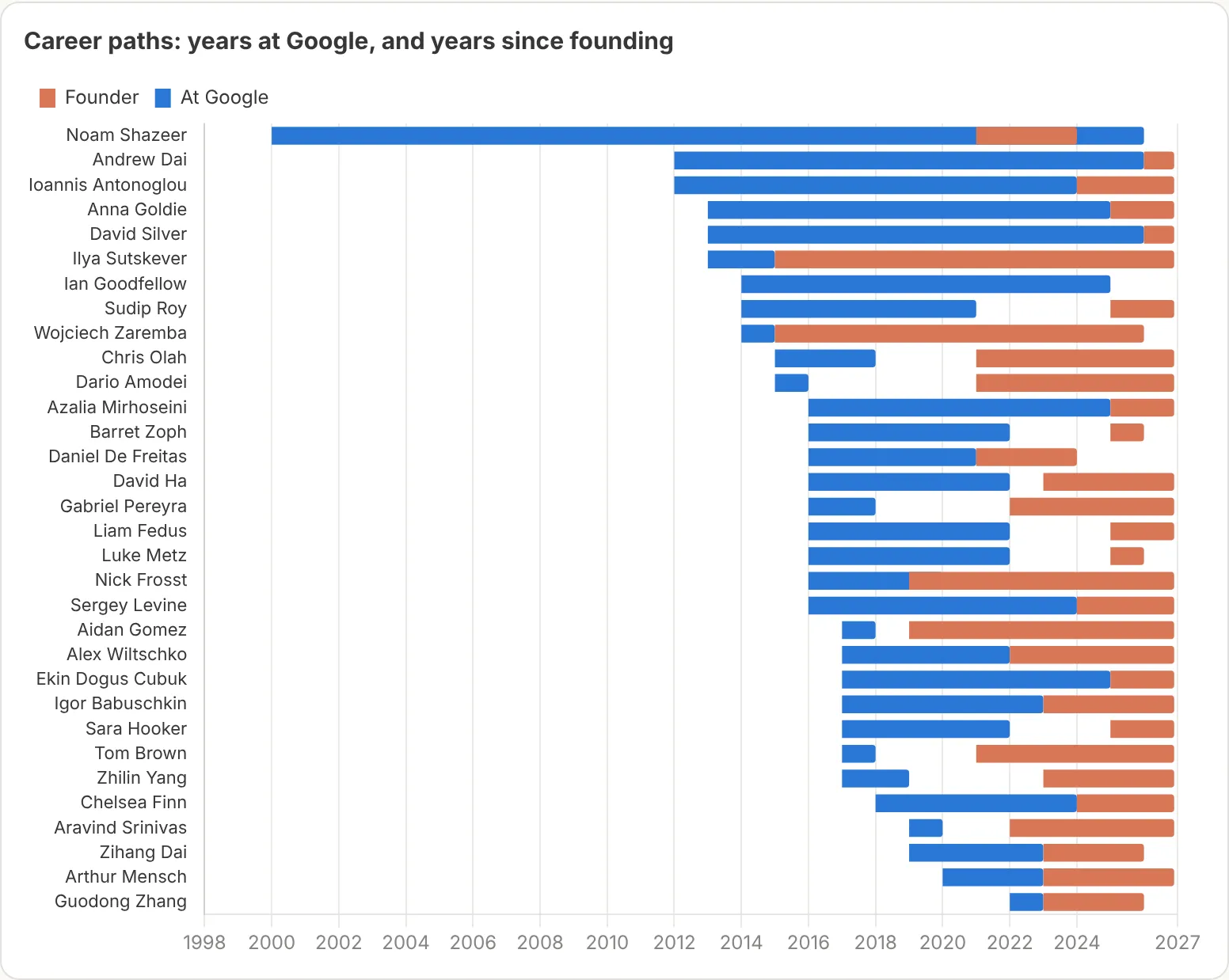
Each row shows one person’s years at Google in blue and years as a founder in orange. Open the timeline in the app.
OpenAI was the main stop in between. 12 of the 32 worked at OpenAI at some point. 8 went from Google to OpenAI and then founded a company. That group includes the three Anthropic founders on the slide and two co-founders of Thinking Machines Lab. Another 7 founders spent time at a different company first, such as Cohere or Anthropic.
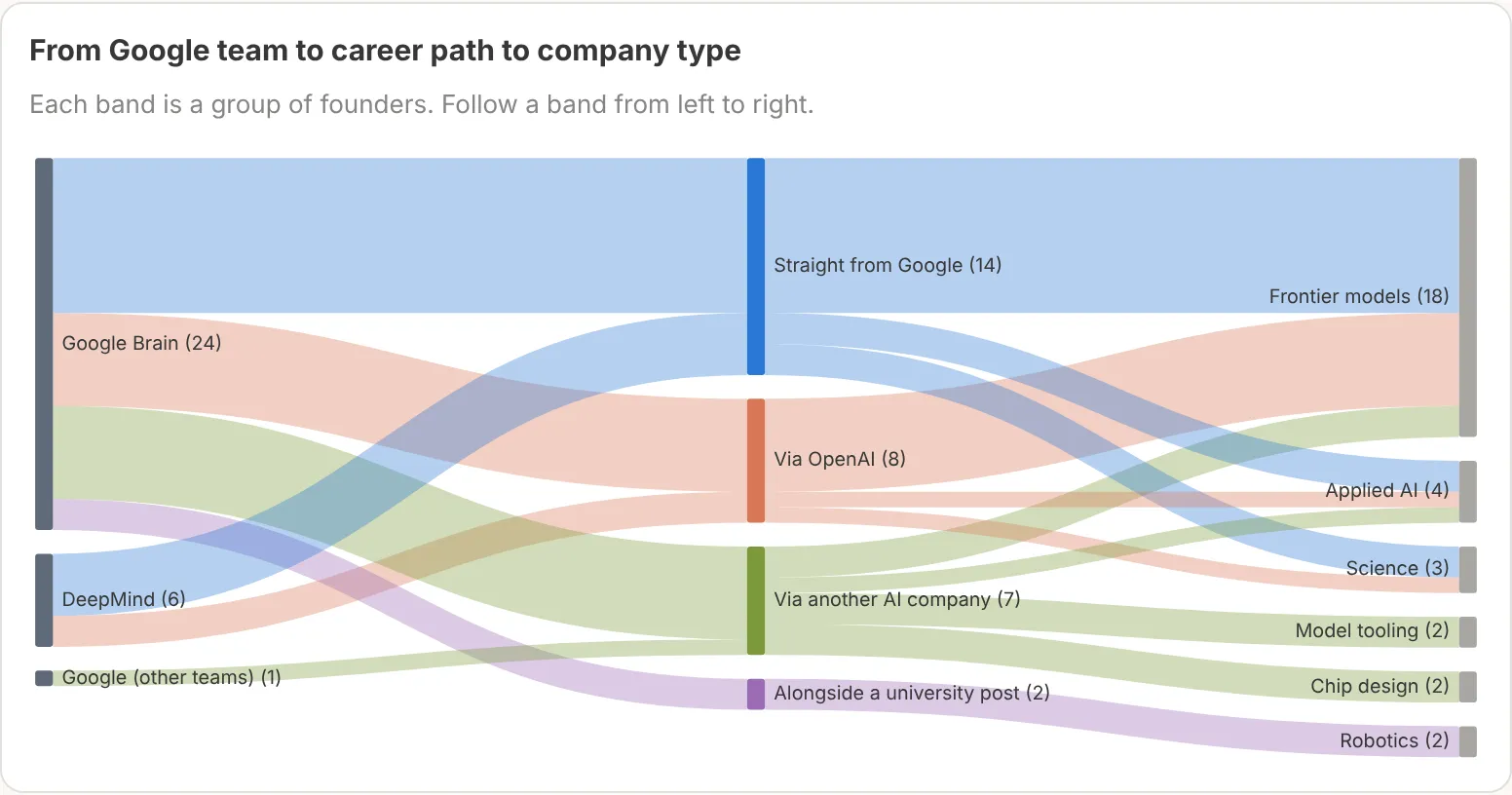
The chart shows how founders moved from their Google team to the type of company they started. Each band is a group of founders. Explore the flow in the app, and use the filters to follow one group.
They founded companies with people they already knew. 10 of the 21 companies have two or three co-founders from the slide. In total, 22 of the 32 people started a company with someone else on the list. Many of these pairs worked side by side at Google first. Anna Goldie and Azalia Mirhoseini co-led AlphaChip, a project that used reinforcement learning to lay out chips. Noam Shazeer and Daniel De Freitas built the Meena chatbot, which became LaMDA. Aidan Gomez and Nick Frosst overlapped at Google Brain in Toronto.
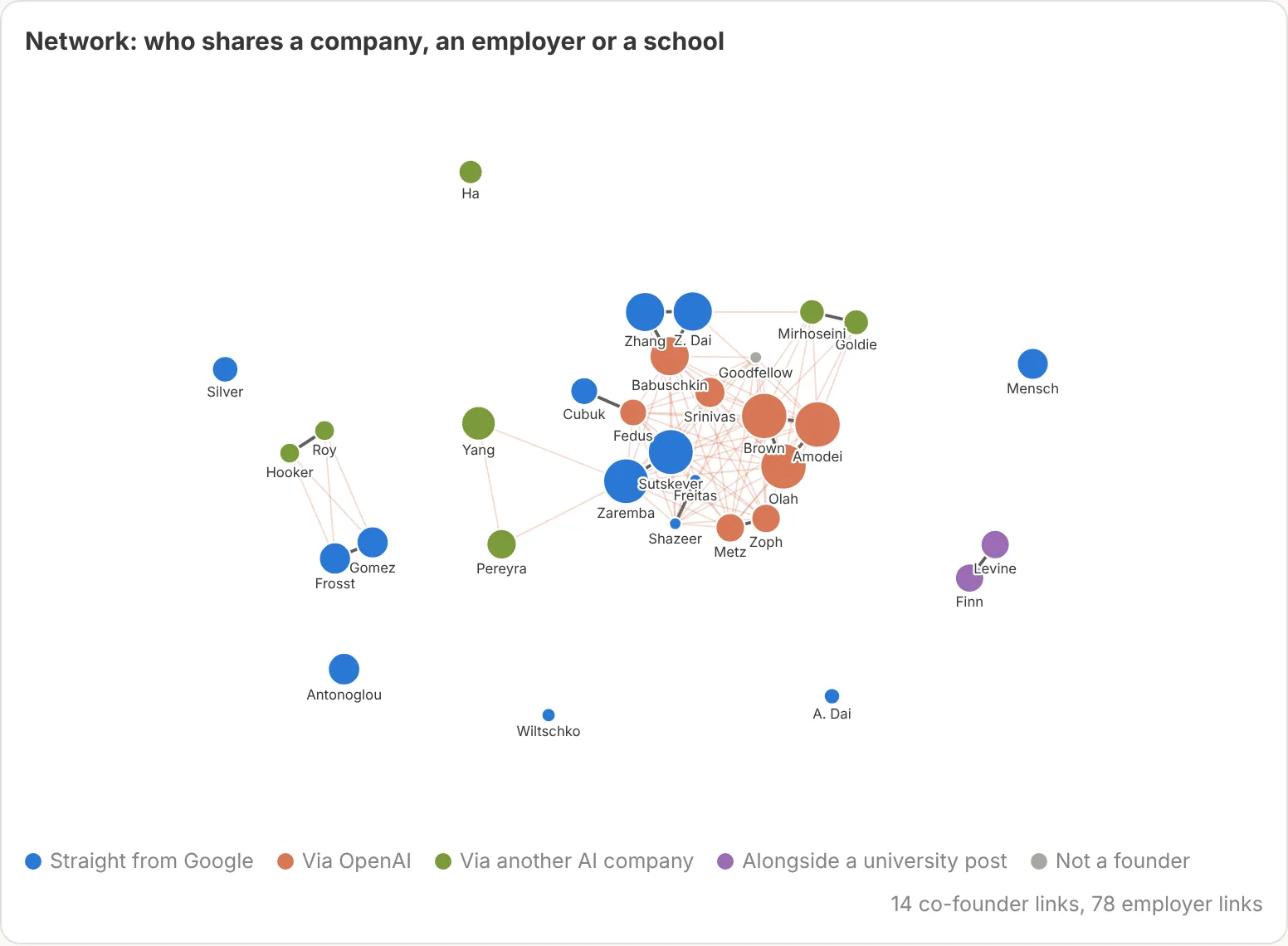
Dark lines join co-founders. Orange lines join people who worked at the same employer outside Google. The people who passed through OpenAI form the dense cluster in the middle. Open the network in the app to highlight anyone’s links or add shared schools.
A few schools come up again and again. The University of Toronto leads with 6 people. Stanford and MIT have 4 each. Canada stands out. 10 of the 32 studied at one of three Canadian universities: Toronto, Montréal or Alberta. Those schools are home to the labs of three pioneers of deep learning and reinforcement learning: Geoffrey Hinton, Yoshua Bengio and Richard Sutton.
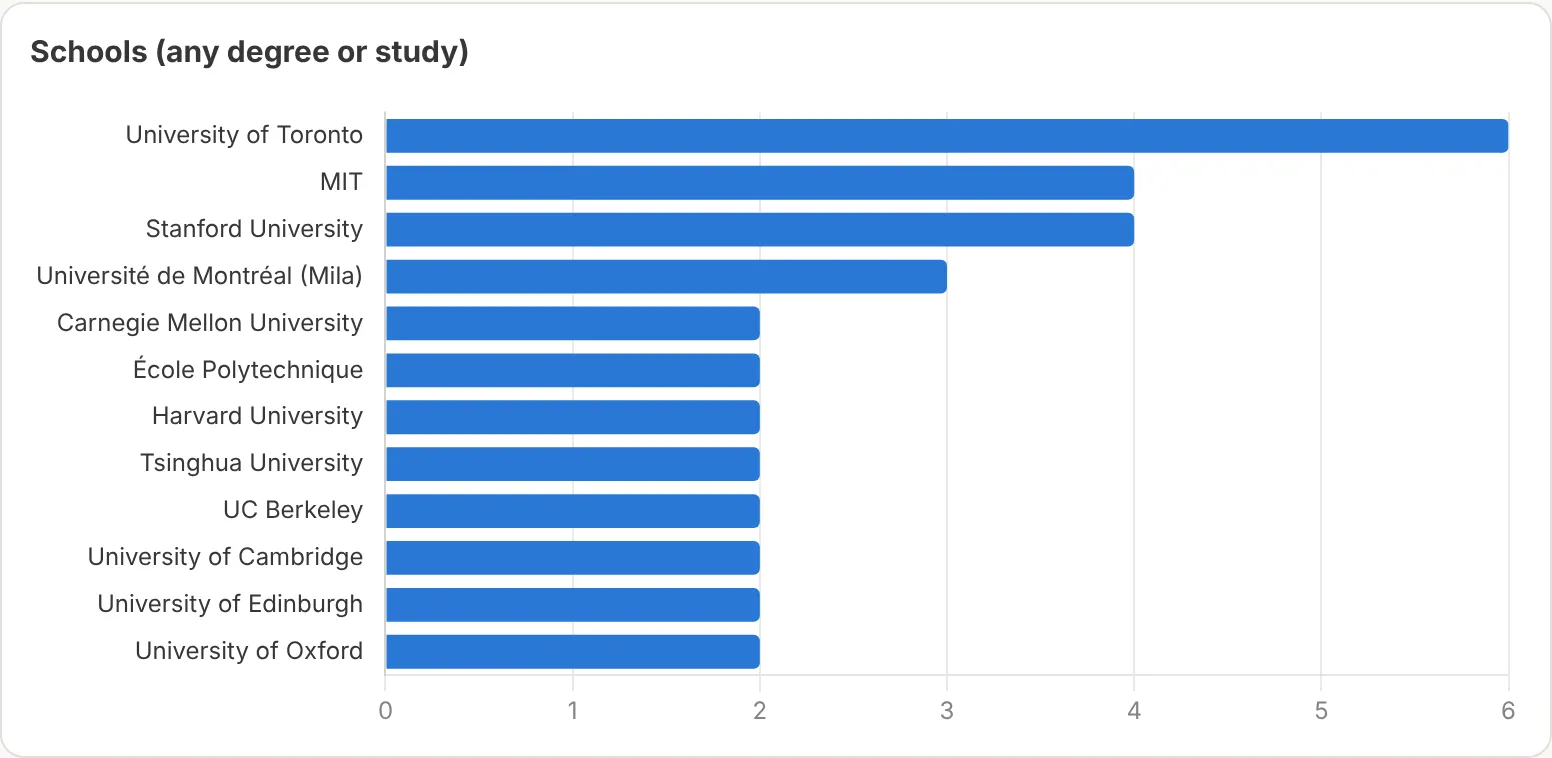
The chart counts schools attended at any level. See the Toronto alumni in the app, or choose another school from the filter.
A PhD is common but not required. 23 of the 32 hold a PhD. Several important model builders do not, including Noam Shazeer, Chris Olah, Barret Zoph and Luke Metz. Many also came from outside computer science. 8 studied physics, neuroscience or cognitive science. Dario Amodei’s PhD is in biophysics, and Alex Wiltschko’s is in neuroscience.
Less time at Google went with larger companies. Founders who spent three years or less at Google built companies with a median value of $150 billion. Founders who spent more than three years built companies with a median value of $7.5 billion. The correlation between years at Google and company value is -0.60. A correlation of -1 would mean a perfect inverse relationship, and 0 would mean no relationship at all.
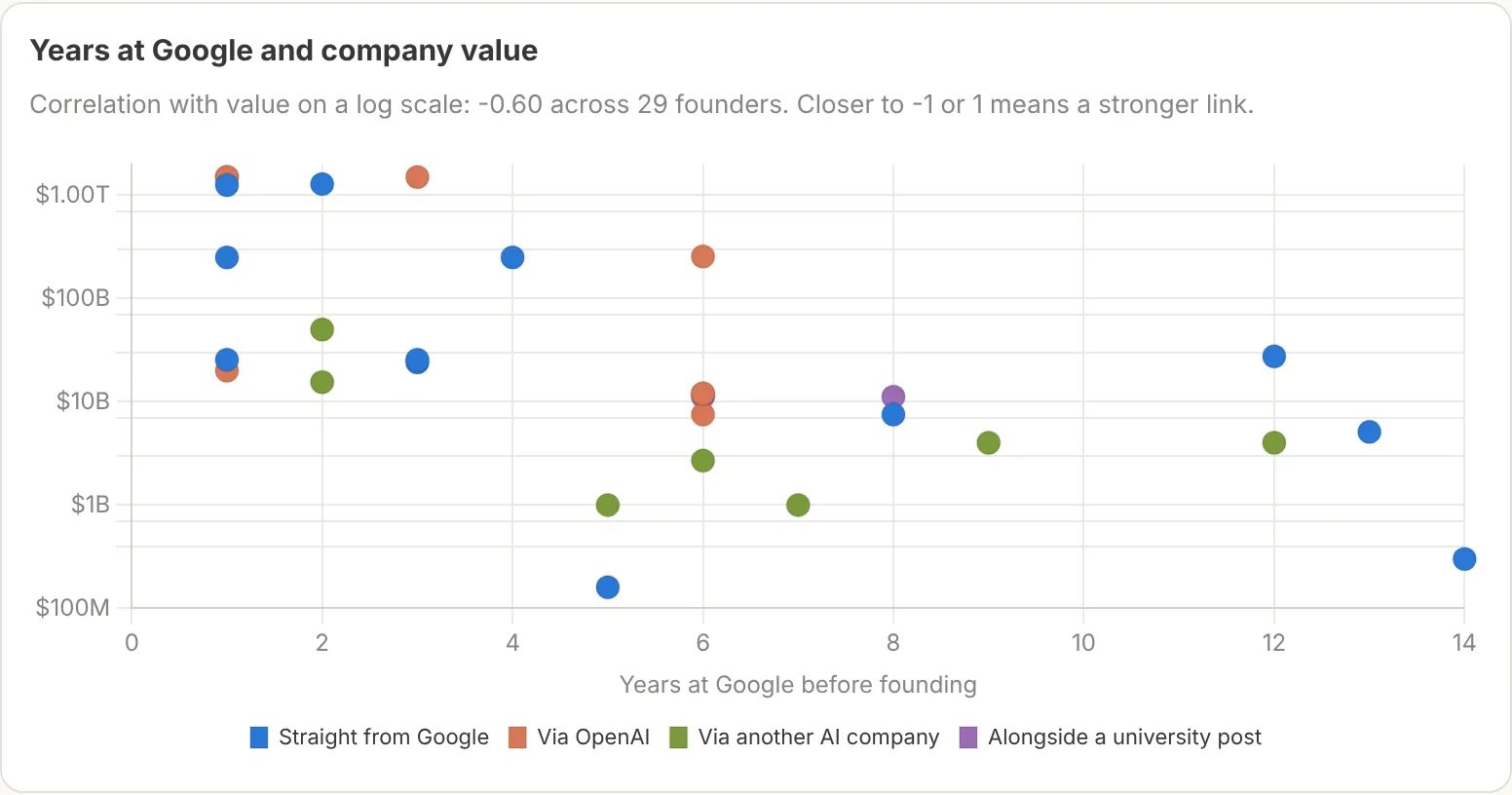
Each dot is a founder. The value axis is on a log scale. Open the chart in the app and use the filters to test the pattern on any group.
I would not read too much into this. The group is small, and the people who left earliest started OpenAI and Anthropic when the field was wide open. Timing likely explains much of the pattern. Still, the pattern holds without the three largest companies, at a correlation of -0.41.
Why do some teams have this kind of reach?
My guess is that several conditions have to coincide. A technical shift must be early enough that its most important applications are still uncertain. An organization must bring together people capable of exploring those possibilities. Those people must spend enough time working together to build shared tools and trust.
The profiles fit that picture. Most of these people arrived at Google within a few years of each other. They worked on the ideas behind today’s models. Then many left within a short span to start companies, often alongside someone they had worked with.
Eventually, some leave to pursue ideas that need a different company or a different market. The team disperses, but what its members learned together travels with them.
This is why the team can be a useful unit of analysis for investors. A company’s products and revenue show part of its impact. The people it develops, and what they build next, can reveal another part that takes longer to see.
The wording on the slide matters. These are alumni of the four founders’ teams, not a verified list of people who reported to Jeff. The group also spans Google Brain and DeepMind, so it would be misleading to assign every person or contribution to Google Brain alone.
None of this means Google or any one leader created the $3.24 trillion. Google recruited remarkable people who brought prior experience. Their later co-founders and teams did the work of building these companies. The figure sums company values from different dates. It is neither realized value nor a measure of anyone’s personal contribution.
Still, the pattern is unusual. A connected set of teams inside Google helped develop important AI technology while becoming a place where many future founders worked. The companies those people built are now pursuing opportunities well beyond the original organization.
That is the question I take from the so-called mafia effect. When a major technology shift begins, which teams are developing both the ideas and the people who will carry it forward?
A note on the numbers
The data is as of November 27, 2026. The total adds company values from different dates. Anthropic is counted at its fully diluted value at the $83 IPO price. OpenAI is counted at the first close of a round that is still open. xAI is counted at its value in the SpaceX merger. These values reflect investor expectations, not realized proceeds.
Character.AI is left out of the total because it filed for bankruptcy in October 2026. Its last equity round, in 2023, valued it at $1 billion. Moonlake AI is left out because Ian Goodfellow is an angel investor there, not a founder. Discovery Loop is left out because the four people who made the slide founded it.
The values for River AI and Adaption Labs each come from a single report. Profiles draw on company pages, university pages, press reports and professional profile data. The companion app lists the source for every company value and every profile.
Selected sources: Anthropic IPO · OpenAI funding round · xAI and SpaceX merger · Character.AI bankruptcy · Moonlake team and investors · Discovery Loop founding team
This post is also on Substack, where you can comment.