
The Great Software Inversion - How AI Inverts App Economics
$$$$ to build + $ marginal distribution -> $ to build + $$$$ marginal distribution
The Inversion of App Economics
For forty years, software economics worked the same way: spend a lot to build, spend almost nothing to serve. Engineering teams were expensive. Deploying bits to one more customer was basically free. This is what created 80%+ gross margins and made SaaS one of the highest-margin business models in technology.
AI is inverting this.
The cost to build an application is collapsing. Tools like Claude Code, Cursor, and Replit let a single developer, or a non-developer, ship working software in days. Features that took a team of five a quarter now take a weekend. “Vibe coding” started as a meme, but functional applications are now being built by people who couldn’t have built them two years ago.
The cost didn’t disappear. It moved.
Every AI-native application that calls a foundation model is paying per inference. Every query, every agent loop, every token is a marginal cost. The more users you have, the more you pay. This is the exact opposite of traditional software, where the marginal cost of the 10,000th user was approximately zero.
The cost structure of software has flipped.
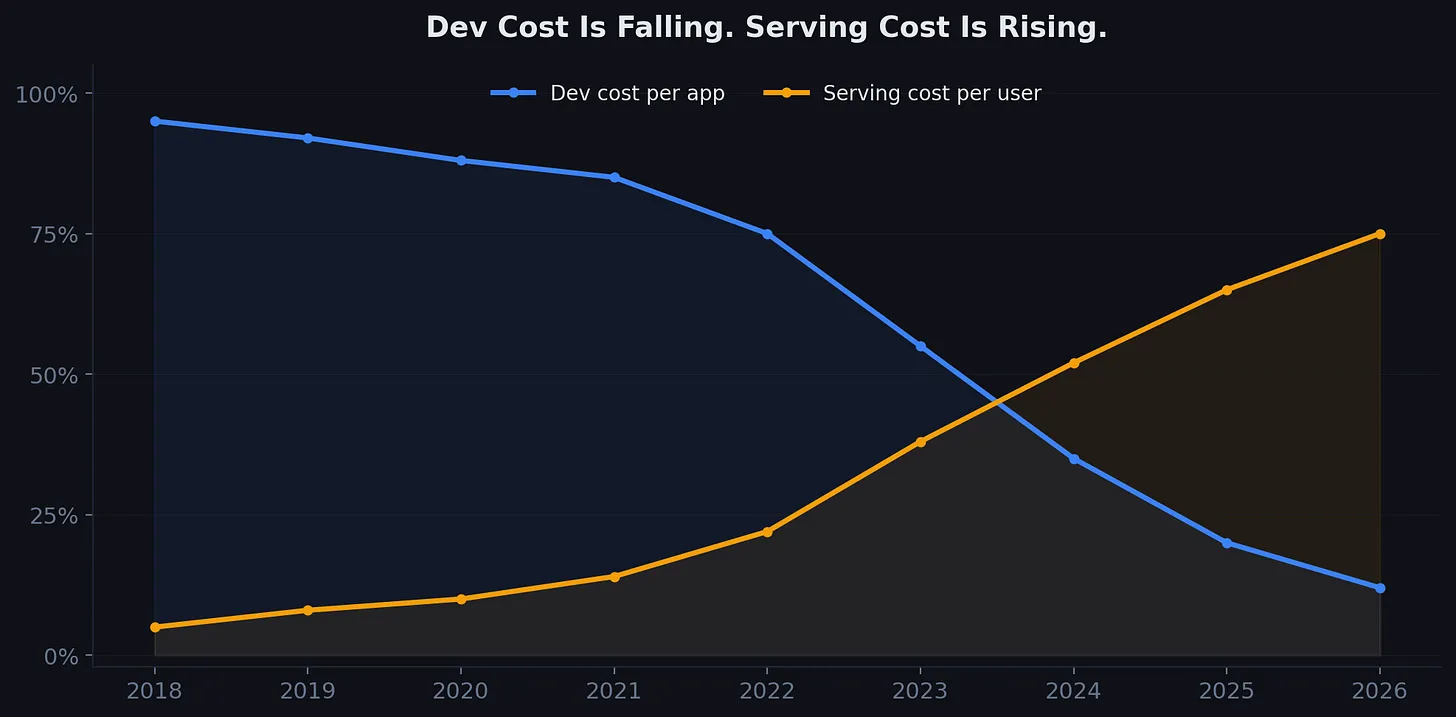
Development cost per application has been falling since Claude unlocked AI-assisted coding. Meanwhile, the cost to serve each user has been climbing as applications become more inference-heavy.
What this does to margins
Traditional SaaS runs at 80%+ gross margins. This is what makes the model so attractive: once you’ve built the product, revenue scales while costs stay flat.
AI-native applications don’t work this way. Inference is a variable cost that scales with usage. The more successful your product, the higher your GPU bill.
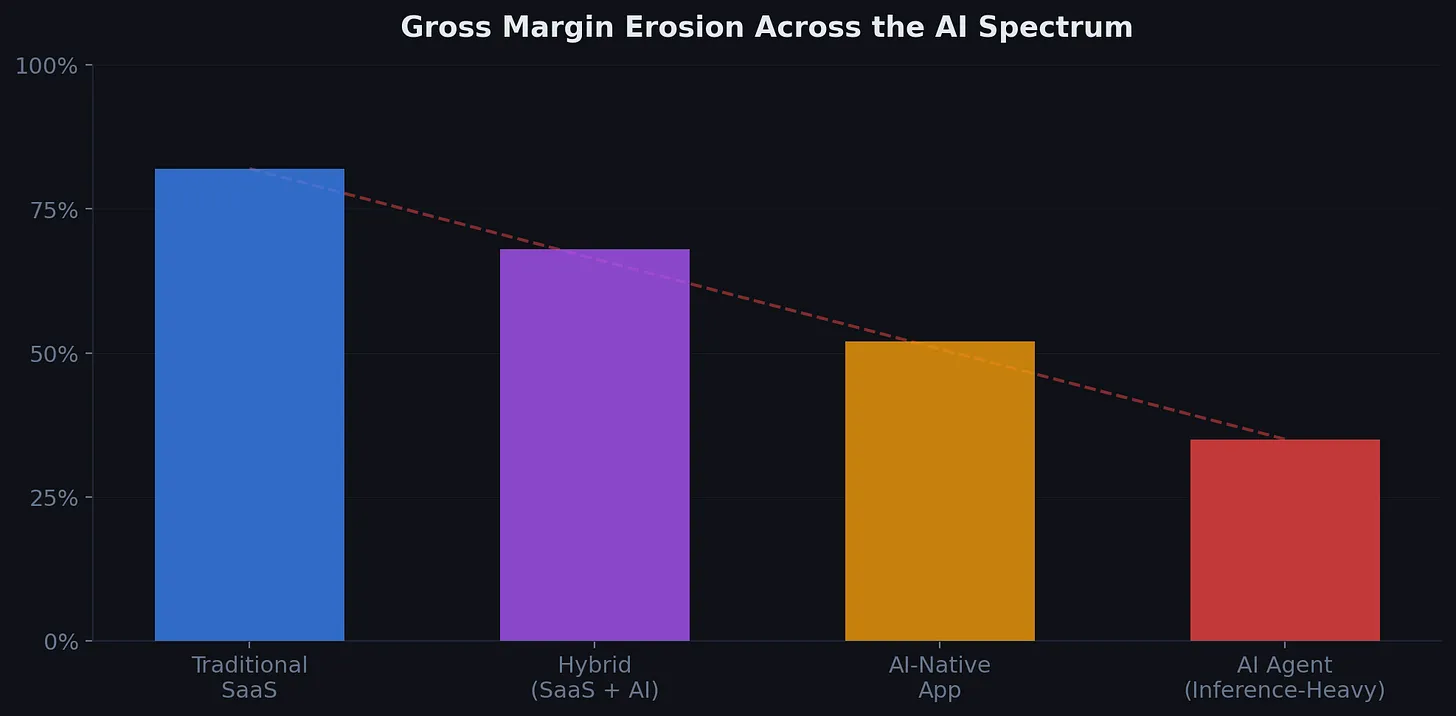
This is already showing up in financials. Companies that started as SaaS and added AI features are watching margins compress from the mid-80s into the 70s, or lower. Pure AI-native applications - the ones built entirely around model inference - are running at 40-55% gross margins after the initial phase of often negative gross margins! Agentic products that loop multiple model calls per task can be even lower.
This matters because the entire SaaS valuation framework was built on the assumption of high gross margins. A 10x revenue multiple on an 80% margin business is very different from a 10x multiple on a 50% margin business.
Follow the money inside the company
The composition of spend is flipping even if total costs stay similar.
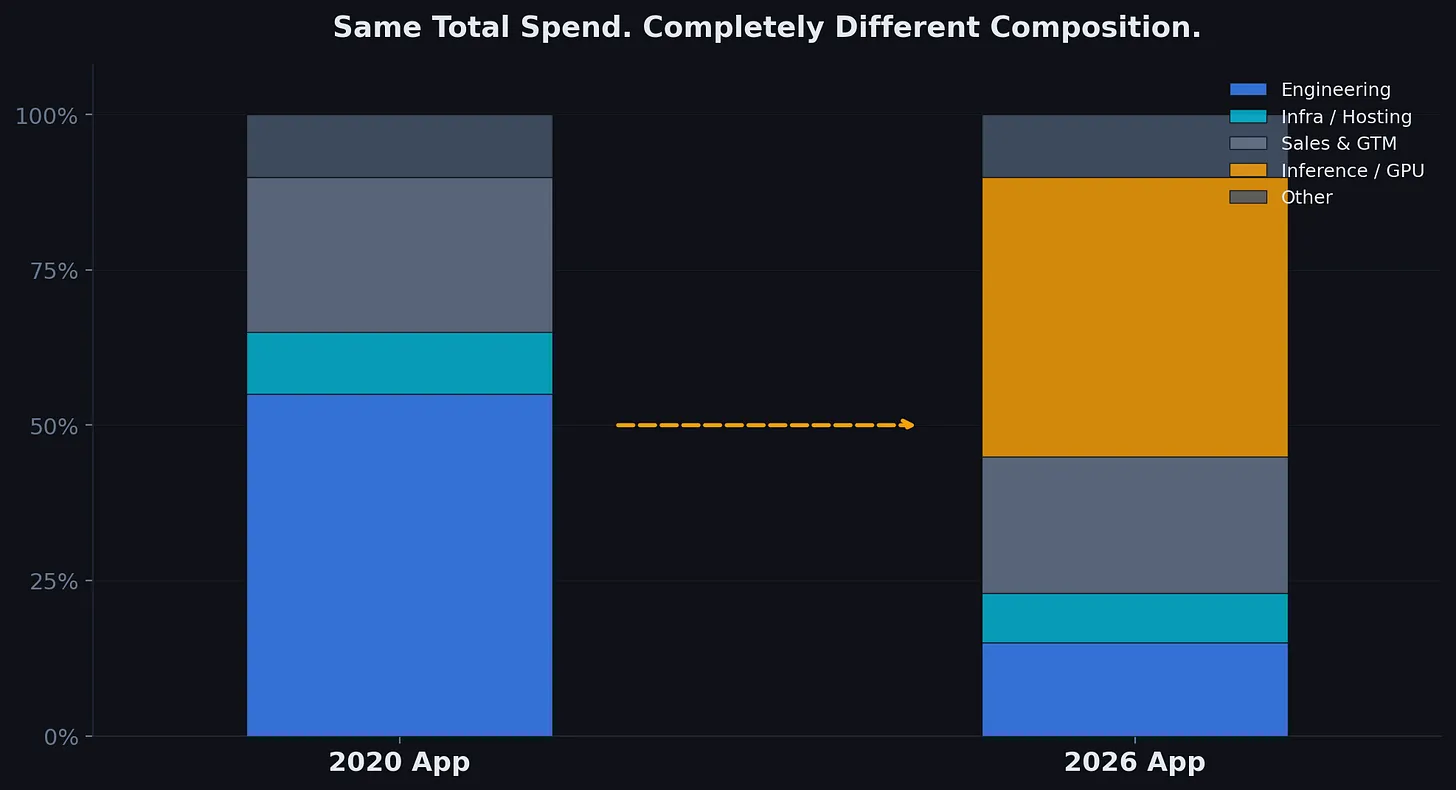
In 2020, engineering salaries were 50-60% of a startup’s cost structure. Infrastructure was 8-10%. In 2026, engineering is shrinking to 15-20% as AI accelerates development. But inference and GPU costs now account for 40-50% of spend. Sales and GTM remain roughly constant.
So even if you have the same total burn, the composition changes significantly. The implications for hiring, fundraising, and unit economics are significant.
The supply flood
There’s a second-order effect that may matter more than margins.
When the cost to build drops to near zero, supply explodes. Every product manager, domain expert, and hobbyist with a good idea can now ship software. The barrier to entry is nearly gone.
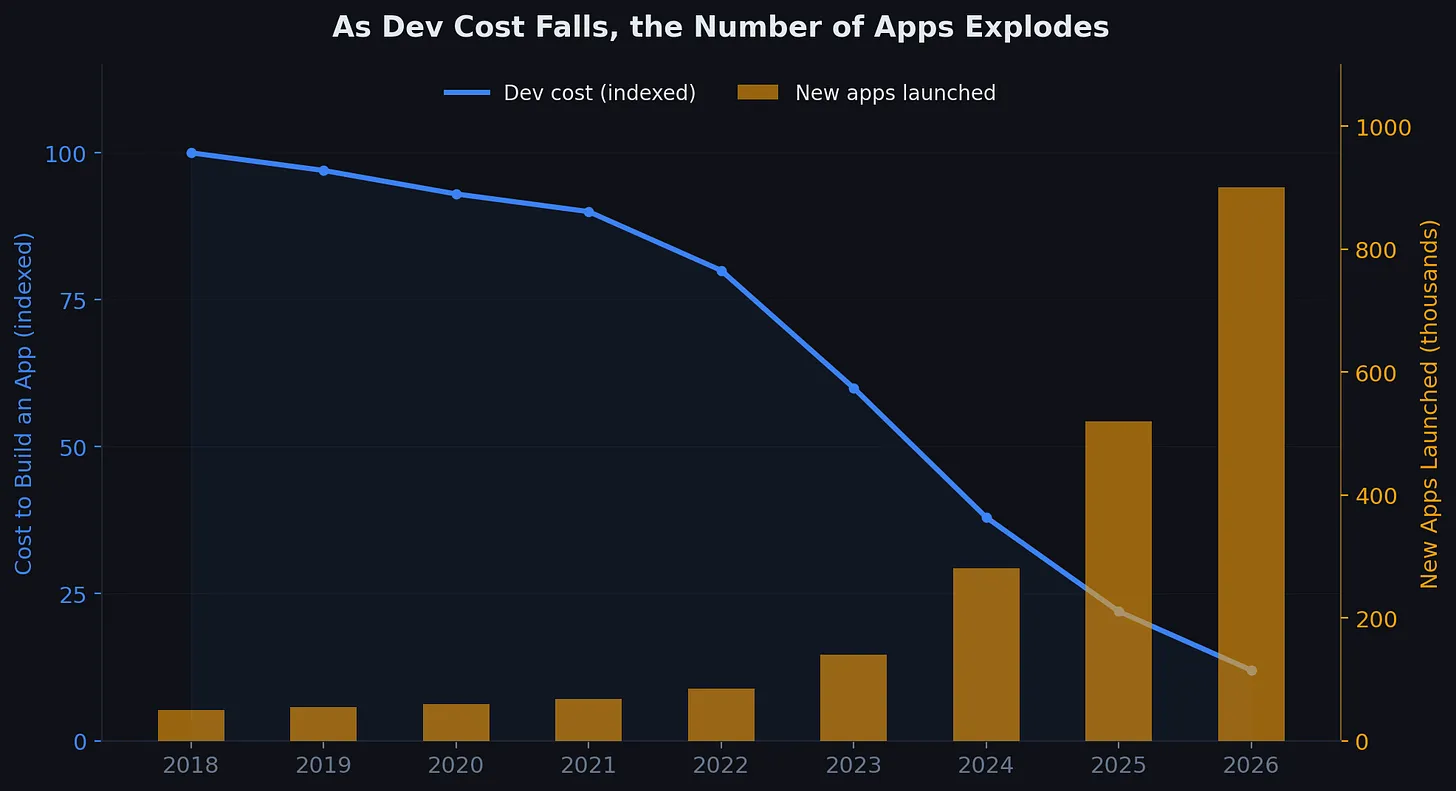
When supply increases dramatically and demand stays relatively constant, the risk is that prices compress. More apps at every price point. More competition in every niche.
The moat shifts from building to distribution, retention, and data network effects.
The movie vs. live theater
Traditional software is a movie. You spend $200M on production (engineering team), years getting it right, but once it ships, streaming it to one more viewer costs nearly nothing. High fixed costs, near-zero variable costs. Great margins.
AI-native software is live theater. The show is cheap to put on - small cast, minimal set. But every performance requires real actors, a real venue, real crew. The more popular the show, the more it costs to run. There are no economies of scale on the marginal performance.
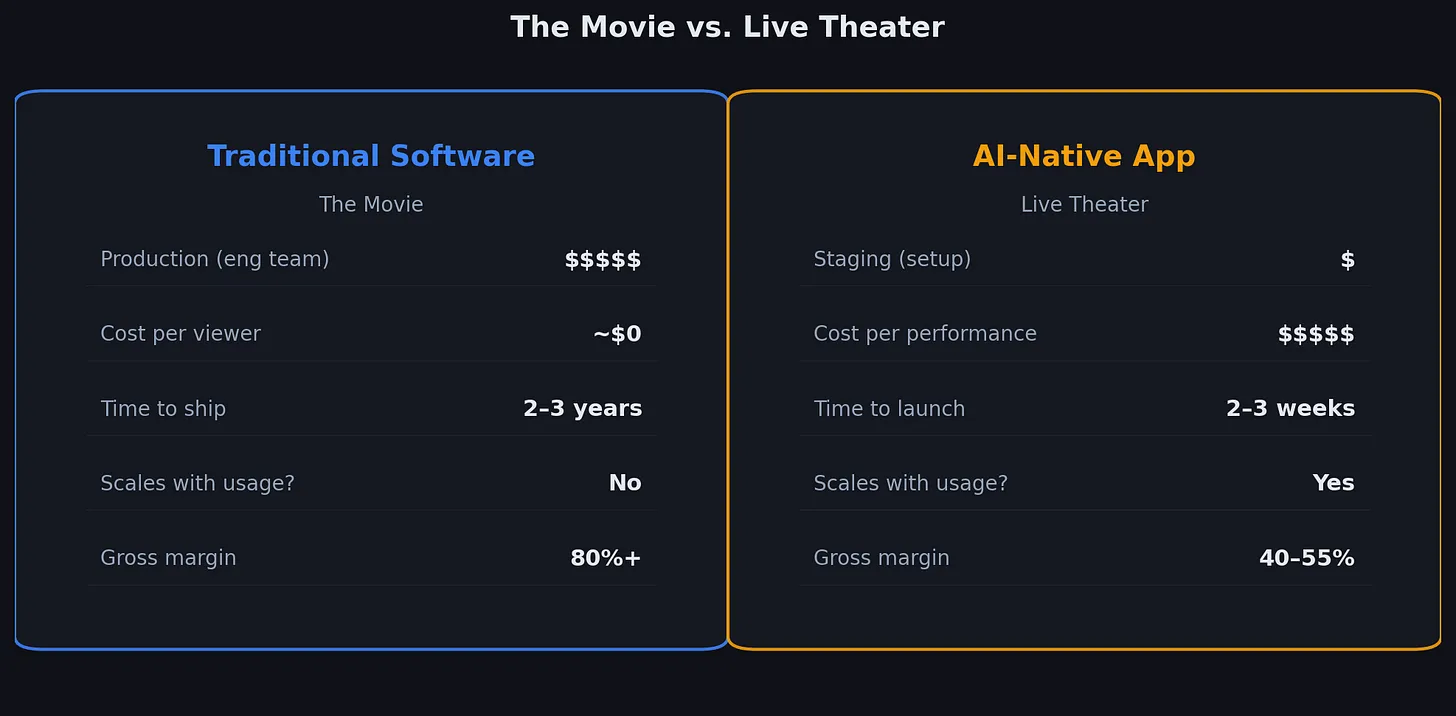
Both can work. But they require fundamentally different strategies for pricing, fundraising, scaling, and competing.
What this means
A few things I’m watching:
Pricing has to change. Seat-based pricing makes no sense when your costs scale with usage, not users. Consumption-based models are the natural fit for AI-native products, but they’re harder to sell to enterprises that want predictable budgets.
Inference efficiency is the new performance engineering. Competitive advantage will come from delivering the same quality output at lower inference cost. Model distillation, caching, routing between models of different sizes - this is where operational excellence shows up.
Distribution becomes everything. If building is cheap, the bottleneck is getting in front of customers and staying there. Brand, community, integrations, and switching costs are what matter.
Valuation frameworks need updating. Applying SaaS multiples to AI-native businesses without adjusting for margin structure is a mistake. We need new benchmarks.
High-margin, scalable SaaS isn’t going away. But it’s no longer the default. The next generation of applications will need to earn their margins through inference efficiency and distribution advantages, not just through the inherent leverage of software.
The costs didn’t disappear. They moved.
This post is also on Substack, where you can comment.