
The AI Slow Boil
When continuous progress becomes the enemy of thoughtful execution
In AI, right now we’re somewhere in the “all at once” phase, except most days we don’t recognize that reality because each individual announcement feels incremental.
I want to walk through what’s actually happened in the last 90 days - using Anthropic as the primary case study, though the same dynamics apply to OpenAI, Google, and every other frontier lab. I’m not focused on the hype, just the product shipping.
The models keep getting better and the pace isn’t slowing
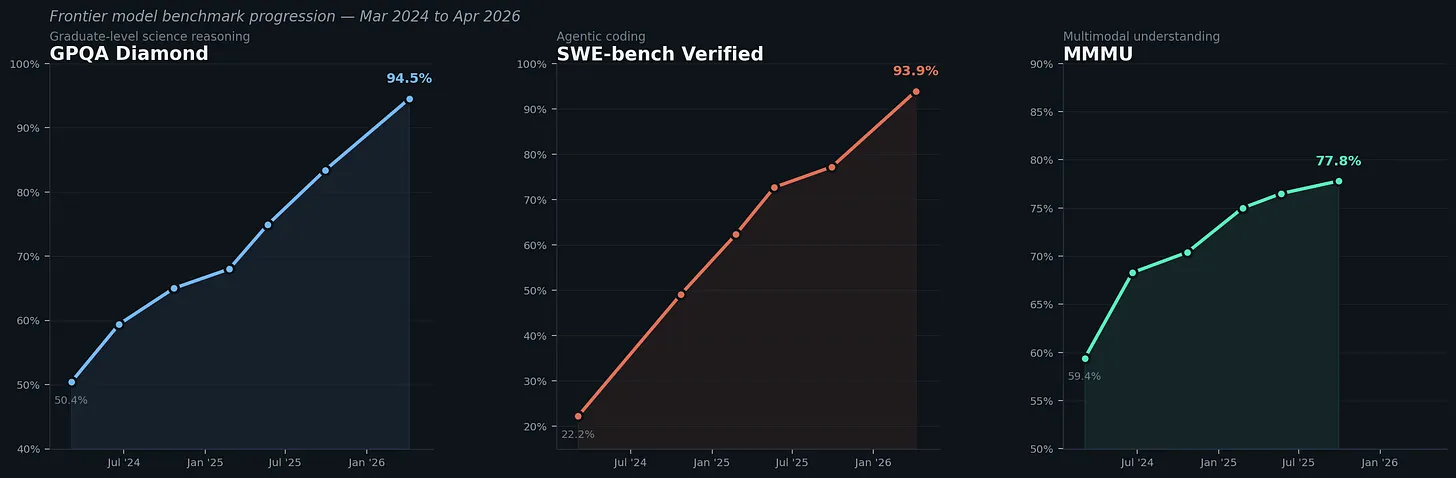
I recently went through the system cards Anthropic has published across every Claude model release over the past two years… from Claude 3 Opus (March 2024) through Mythos Preview (April 2026). Three benchmarks survived long enough across model generations to measure a real trend: GPQA Diamond (graduate-level science reasoning), SWE-bench Verified (agentic coding), and MMMU (multimodal understanding).
The numbers are striking. GPQA Diamond went from 50% to 95%, a 45-point gain in 25 months. SWE-bench Verified, arguably the most practically relevant benchmark because it measures whether a model can actually fix real bugs in real codebases, went from 22% to 94%. That’s a 72-point gain.
More importantly, the gains aren’t decelerating. The last three GPQA jumps are the largest in the series, and the most recent SWE-bench leap of +17 points came after the curve had looked like it was flattening. In the one area that is decelerating (MMMU, multimodal understanding), it’s because the models are approaching human-expert-level performance. The benchmarks are saturating, not the models.
I’ll be the first to admit - benchmarks aren’t the full story. But in this case, the lived experience matches. Anthropic’s internal surveys show their engineers using Claude in 59% of their daily work (up from 28% a year ago) and reporting a 50% productivity boost - roughly a 2x increase in both metrics in just 12 months. Merged pull requests per engineer per day are up 67% since they adopted Claude Code across their engineering org. And 27% of Claude-assisted work consists of tasks that wouldn’t have been done at all otherwise - the kind of exploratory and scaling work that was never cost-effective before.
If Anthropic’s own engineers, building some of the most complex software on the planet, are shipping 67% more code per day, think about what happens when those same gains hit application-layer software development, where the demands on the code are generally less strenuous.
Timelines for everything, product development, competitive response, market entry, are compressing. And the people building the models are compressing their timelines faster than anyone else.
The product cadence is relentless
It’s not just the models getting better - the products built on top of those models are shipping at a pace that would have been considered impossible two years ago.
In Q1 2026 alone, Anthropic shipped:
New models: Claude Opus 4.6 and Sonnet 4.6, with a 1M-token context window, a 14.5-hour task completion horizon, and coding performance that would have been unthinkable 18 months ago. Then Mythos Preview scored 94% on SWE-bench — meaning it can solve nearly all the real-world GitHub issues in the benchmark autonomously.
Agentic infrastructure: Claude Managed Agents — a platform that handles sandboxing, state management, tool orchestration, and error recovery for production AI agents. The exact plumbing that a generation of startups has been building. Priced at $0.08 per session hour plus token costs.
Desktop and computer use: Claude Cowork and Computer Use — AI that can point, click, and navigate your actual screen. Dispatch lets it run tasks while you’re away from your desk. It operates inside Excel, PowerPoint, and your browser natively.
Enterprise connectors: Deep integrations with Google Workspace, Microsoft 365, Salesforce, and dozens of other enterprise tools — not shallow “paste text” integrations, but full context-sharing across applications.
Security tooling: Claude Code Security — reasoning-based vulnerability scanning that found 500+ zero-day vulnerabilities in production open-source code. And Project Glasswing, which deploys Mythos for defensive cybersecurity. AI doing real security research, not just pattern matching.
Memory and personalization: Persistent memory across sessions, available even on free tiers. Claude remembers your preferences, your projects, your working style.
Count it up and you get roughly one major product release every four days. This is from Anthropic alone. And competitive pressure means OpenAI, Google, and others are on a similar cadence.
The stack is getting eaten from below
Here’s the pattern that matters most for anyone building or investing in software:
The frontier labs are shipping across three layers simultaneously:
Model layer (bottom): Better models, bigger context windows, cheaper inference. This is table stakes.
Enablement layer (middle): Agent orchestration, security scanning, observability, enterprise controls, developer CLIs. This is the layer that should worry infrastructure startups the most.
Application layer (top): Desktop agents, office productivity add-ins, computer use, connectors to every major SaaS tool. This is where the labs are making contact with end users directly.
Each layer enables the one above it, and the labs are pushing all three forward at the same time. The pace has been roughly one major release every two weeks since January 2026, and it’s accelerating — the most recent week alone saw launches across all three layers.
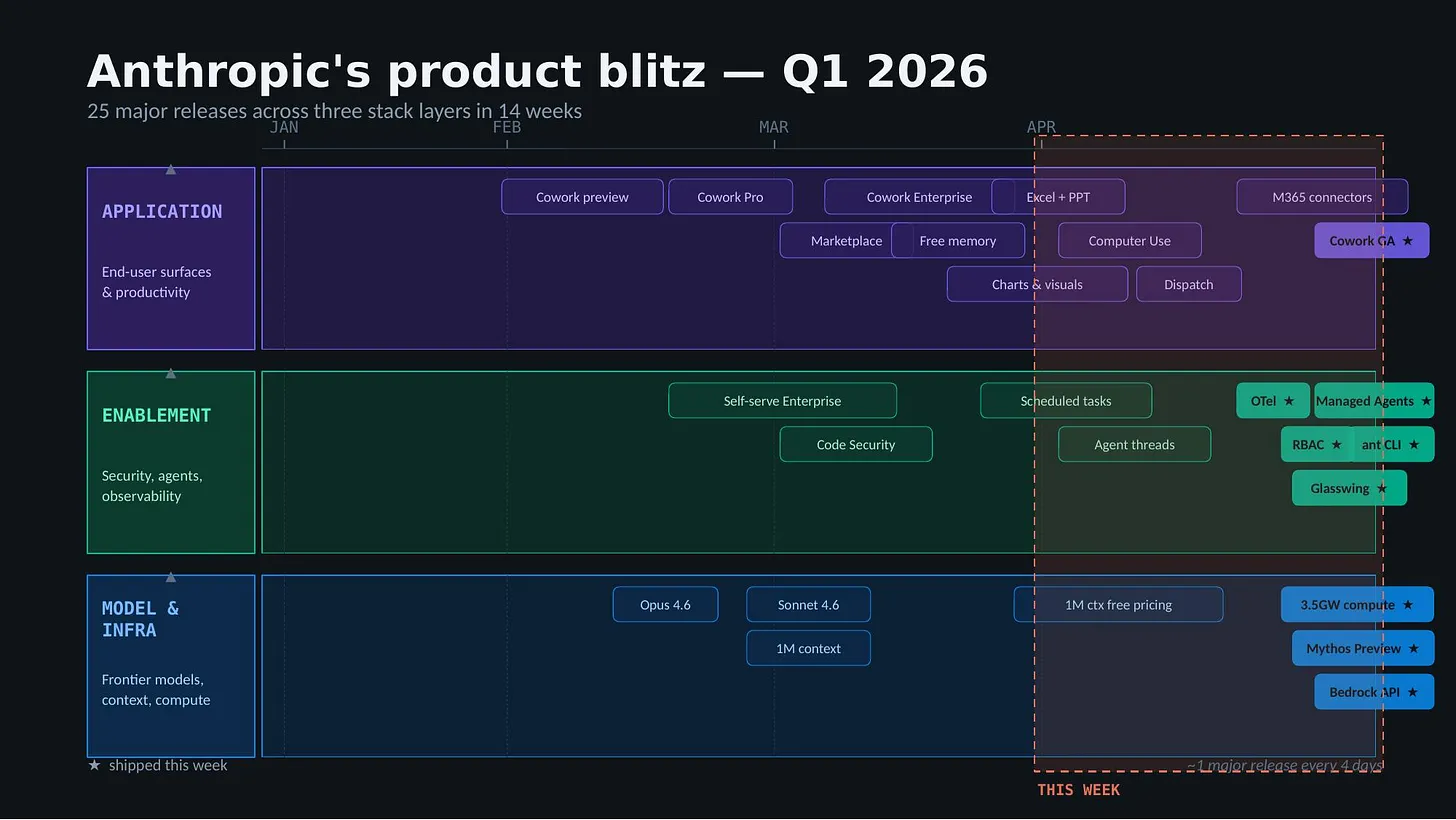
No single announcement is alarming. That’s the slow boil. A managed agents platform here, a security scanner there, an Excel integration next week. But zoom out to the quarterly view and you realize the platform vendors are systematically subsuming layers of the stack that were supposed to be startup opportunities.
The Anthropic Managed Agents Introduction
To me, one of the most interesting recent launches was the managed agent infrastructure. Anthropic’s Claude Managed Agents is a complete cloud service for building and deploying production AI agents: secure sandboxed execution, persistent sessions, credential management, multi-agent coordination, and error recovery. All via API.
Major SaaS companies like Notion, Asana, and Sentry are already building on it. The pricing is extremely compelling - pennies per session hour plus token costs.
This matters because it competes with the agent platform layer - the orchestration, sandboxing, and deployment infrastructure that dozens of well-funded startups are building right now. If the model provider handles the plumbing at commodity pricing, the value proposition of standalone agent infrastructure companies narrows considerably. The startup whose primary differentiation is “we make it easy to deploy and manage AI agents” now has a very well-funded competitor that also controls the underlying model.
And the trajectory is clear. Today it’s agent infrastructure. Tomorrow it’s vertical agent applications - customer service, finance, HR. The platform doesn’t have to build every vertical itself. It just needs to make it trivially easy for anyone to build agents on their platform, which is exactly what managed agent infrastructure does.
What does durable value look like?
I don’t have a clean answer. But I think the right questions are:
Where does the model vendor stop? History suggests platform vendors are great at horizontal infrastructure and terrible at deep vertical workflows. Salesforce built the platform but didn’t build every app on it. AWS built the cloud but didn’t build every SaaS product. Anthropic and its peers will likely follow the same pattern — but the “horizontal” surface area they’re claiming is much larger than we expected a year ago.
What survives the benchmark treadmill? If a coding model can solve 94% of SWE-bench today, what does a developer tools company need to offer that the model can’t do natively by next year? The answer has to be something beyond “we wrap the model in a nice UI” — it needs to be proprietary data, workflow lock-in, or domain expertise that’s genuinely hard to replicate.
Where does compression create opportunity? If product development timelines are getting cut in half, that doesn’t just threaten existing companies — it makes entirely new categories viable. Products that weren’t worth building when development took 18 months might be worth building when it takes 3. The question is who captures that value — the AI-native startup that moves fast, or the incumbent that suddenly has the engineering bandwidth to expand?
The Slow Boil
The AI slow boil is real. Each week’s announcement feels manageable - a new model here, a new integration there, an agent platform launch. No single event forces you to rethink your worldview.
But string together the last 90 days and the picture is different. Models that went from 50% to 95% on graduate-level reasoning. Coding agents that solve nearly every benchmark task autonomously. Desktop agents that can use your computer while you’re at lunch. Managed infrastructure that lets anyone deploy production agents in days. Enterprise connectors into every major productivity tool.
And question we should all be asking ourselves - no matter where we sit in the ecosystem and in what role - are we experiencing the slow boil? Is it time to stop and thoughtfully evaluate our worldview in light of the relentless improvements?
I’m encouraging myself, and every founder I work with, to take the time to truly internalize these compounding AI improvements and consider the opportunities and threats they represent… rather than be in the slow boil, passively trying to absorb the daily crescendo of announcements.
This post is also on Substack, where you can comment.