
Price the Whole Round
I’ve raised multiple rounds as a founder, and now I see those same decisions from the other side of the table as an investor. When a company has momentum and several investors are interested, I like to ask how much capital is available at each valuation.
Say you’re a few rounds in and need $100 million to reach your next set of milestones. The business has grown significantly since you last raised at a $250 million valuation. If you offered that price again today, you might see $500 million of interest.
At $1.5 billion, say you have $125 million of interest. That gives you a $25 million cushion if a few investors reduce their checks or drop out. Push to $1.6 billion and total interest drops to $50 million, including the $40 million lead check. You still need $60 million alongside the lead, and you have only $10 million of other interest.
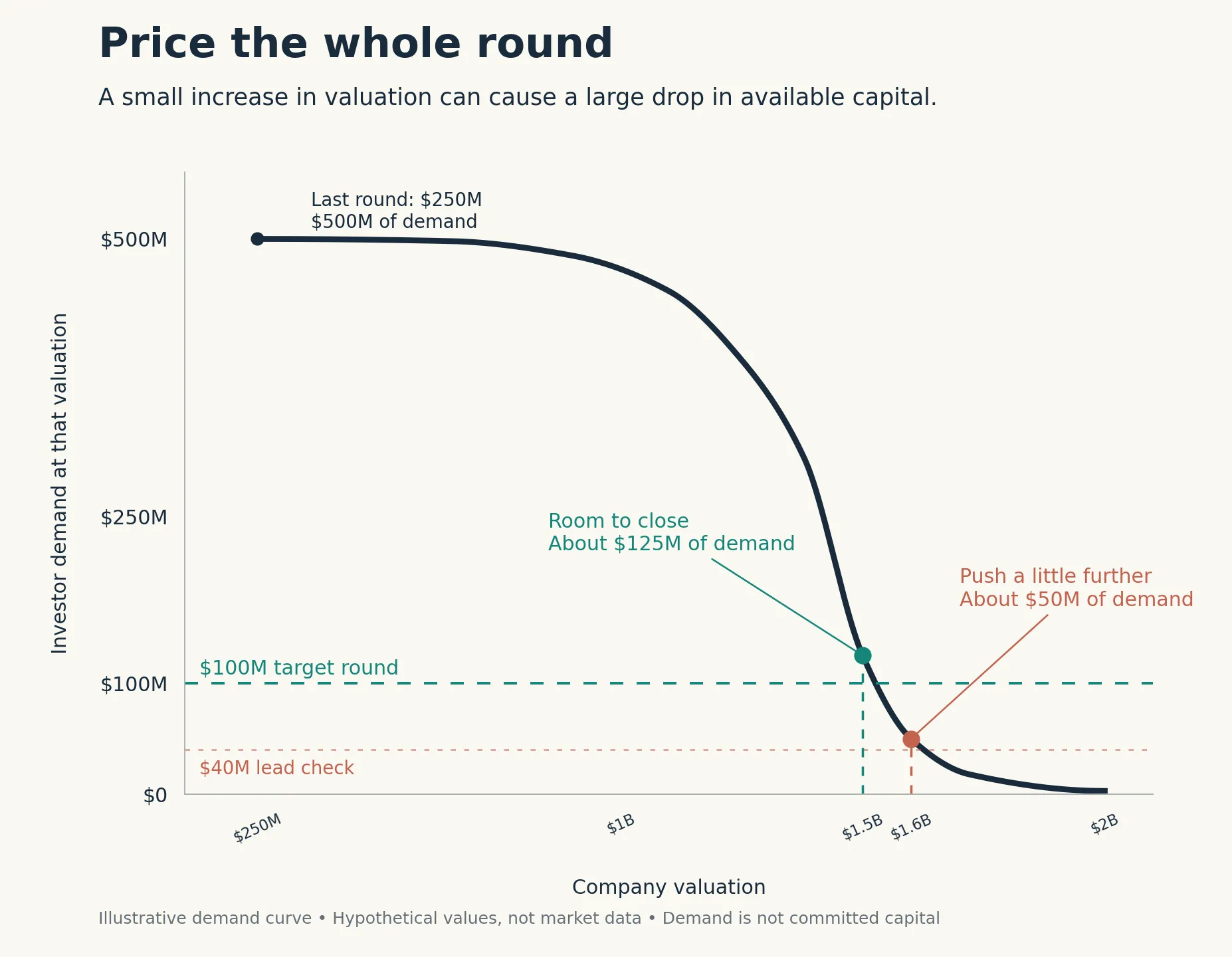
Investor interest can hold up through several price increases and then drop sharply. A few investors can reach their limits at roughly the same price. The lead may still be willing to invest, even as most of the other capital you were counting on disappears.
That includes your existing investors. Even if they have pro rata rights, ask whether they’ll use them at the proposed valuation. Some may pass or be unable to get approval for the check. That’s how a fundraise with a strong lead term sheet can drag on.
I’d start with how much capital the business needs, then test demand for the full amount at the price you’re considering. Who will come in alongside the lead? How much will they invest at that price? How much of the interest you’re counting on came from conversations at a lower valuation?
I’d push for a valuation where there’s enough credible demand to fill the round comfortably and some competition for the remaining allocation. In this example, I’d take the $1.5 billion valuation and get back to building.
This post is also on Substack, where you can comment.