
If you can verify it, you can build it
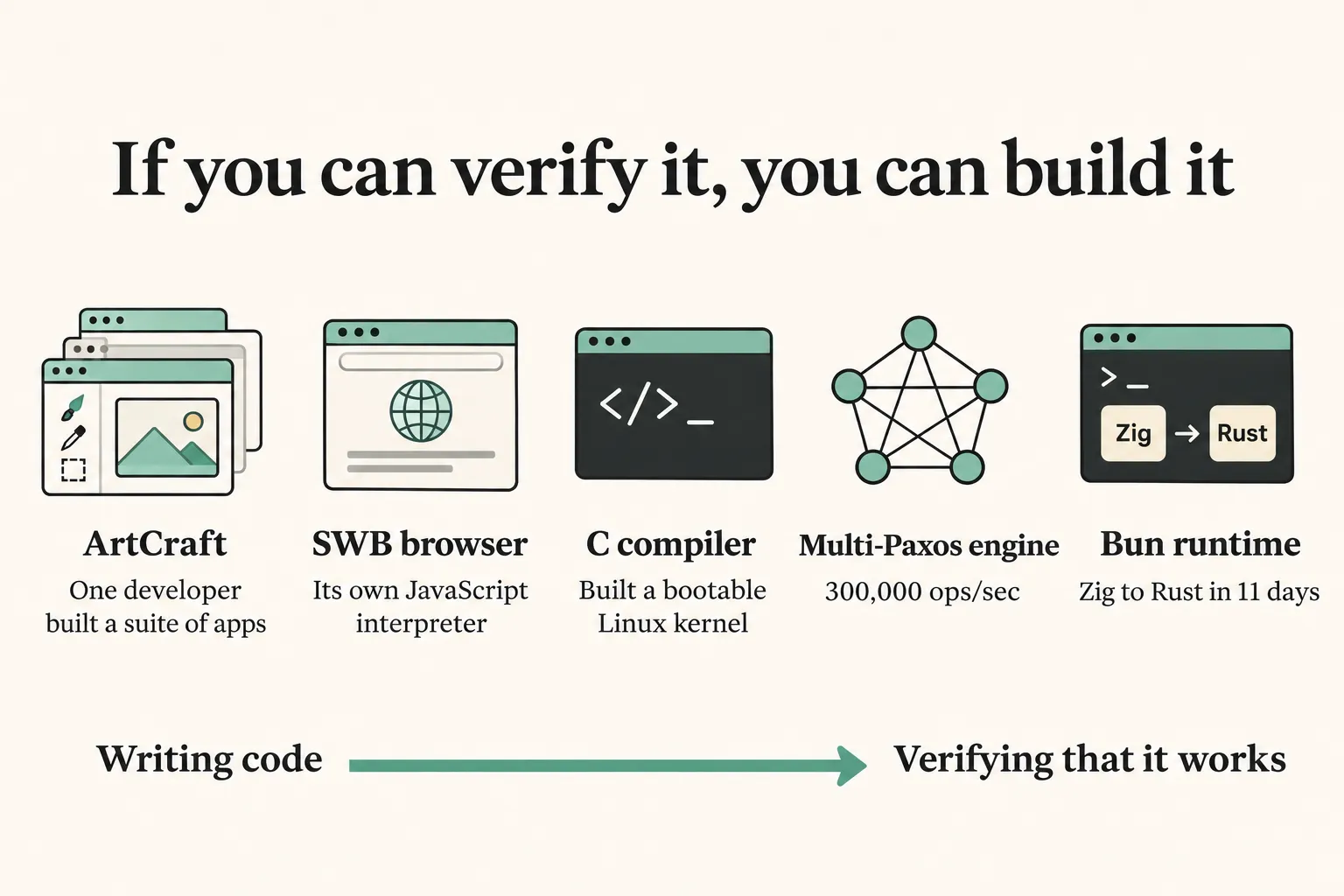
A working script used to be a good result from a coding model. Then came whole pull requests. Now engineers are using coding agents to build browsers and C compilers and to rewrite production runtimes.
What interests me is how these projects were verified. Give an agent a reliable way to check its work and it can make a change, see what broke, and try again. It can keep doing that for days. That starts to make projects feasible that would have been too big for the people taking them on.
What the agents could verify
ArtCraft. One developer ran agents in parallel to build a suite of open-source creative and productivity apps in Rust, including alternatives to Photoshop, Premiere Pro, Word, and Excel. Most are still early. You can check whether a photo editor opens and exports an image pretty quickly. Verifying that it handles the file formats and workflows people depend on is a much bigger job.
A web browser. Senko Rašić used Claude to build SWB, an experimental browser in Rust. In under two months, it grew to roughly 400,000 lines of application code and 500,000 lines of tests. It renders standard websites and has its own JavaScript interpreter. Support for the web APIs that more complex sites depend on is still incomplete.
A C compiler. Anthropic’s Nicholas Carlini ran 16 Claude agents in parallel to build a C compiler in Rust. Over two weeks and nearly 2,000 Claude Code sessions, they wrote about 100,000 lines of code. The compiler built bootable Linux kernels for multiple architectures and compiled large projects like QEMU, FFmpeg, and PostgreSQL. Carlini spent much of his time building the tests the agents used to check their work. The compiler could build a kernel, and there was still work to do on the toolchain and on the speed of the binaries it produced.
A distributed consensus engine. Cheng Huang used agents to build a Multi-Paxos engine in Rust. In six weeks the project grew to more than 130,000 lines of code, and throughput went from 23,000 to 300,000 operations per second. Huang used more than 1,300 tests, as well as code contracts, property-based testing, and failure injection. For a system like this, you want to know how fast it is and whether it can still recover after a failure.
Bun’s language migration. Jarred Sumner used dozens of Claude Code workflows to rewrite the Bun JavaScript runtime from Zig to Rust. The migration took 11 days, and the merged diff added more than a million lines. Bun already had a large test suite and CI across platforms. More than a million assertions passed without skipping or removing a test. The team also did security reviews and targeted fuzzing. Some regressions still had to be fixed after release.
Bun had an advantage that a new project usually doesn’t. The Zig version gave the team a reference for how the software should behave. If you’re starting from scratch, you have to decide what the software should do and how you’ll know when it does it.
Where engineers spend their time
For a rewrite, I’d start by running the old and new versions on the same inputs and comparing the results. For a new feature, I’d pick a few real user workflows and turn as much of that behavior as I could into checks the agent can run on its own. The more specific the checks, the easier it is for the agent to tell which change broke something.
It also matters how long those checks take. A test that runs in a few seconds can guide every change. A suite that takes an hour is more useful before you merge. Clear interfaces help here too. Two agents can work on different parts of the codebase if each can check its work independently.
Engineers still have to decide what’s good enough to ship. That includes deciding which workloads to benchmark, which changes need a manual review, and what to measure after release. Bun’s regressions are a good reminder that some behaviors only show up when people run their own applications.
What becomes worth building
Most engineering teams have a list of projects they’d do if they had more time. An internal tool, a niche integration, a rewrite of a component nobody wants to touch. I’d revisit the projects where it’s already clear what a good result looks like. A rewrite with years of tests and production traces may be easier to hand to an agent than a smaller project with vague requirements.
This changes the math for small teams. They can take on more of the work themselves, and their competitors can do the same. If a feature is easy to reproduce, customers still care whether it fits their workflow, integrates with the systems they already use, and works reliably.
Pick a project you’ve been putting off and ask how you’d verify it. If you can answer that, it may be a lot closer to getting built than you thought.
This post is also on Substack, where you can comment.