
How Big Can AI Get? Let's Do the Math (TLDR- a LOT bigger)
AI Is Less Than 1% Into the Knowledge Work Economy
Everyone talks about how fast AI is growing. And it is — enterprise AI spending tripled in 2025 to $37 billion and has only accelerated this year. But here’s the thing that keeps hitting me when I look at the actual numbers: the entire AI industry has captured less than 1% of the knowledge worker labor market it’s going after.
I get though where continued questions around “how much more can AI Labs grow” come from - the numbers are mind-boggling, and so the questions are understandable!
So here’s a rough back of the envelope discussion among over dinner with a select group of GTM leaders at the AI Labs.
There are roughly 100 million knowledge workers in the US earning a combined $10–11 trillion a year. Software engineers, lawyers, consultants, financial analysts, customer service reps, healthcare administrators, marketers, educators, government workers. That’s the real TAM for AI — not the $700B software market where we are seeing so much of the action, but the multi-trillion dollar labor market.
I put together a chart breaking this down by vertical. The penetration numbers aren’t supposed to be precise, but more directionally indicative of where things are today:
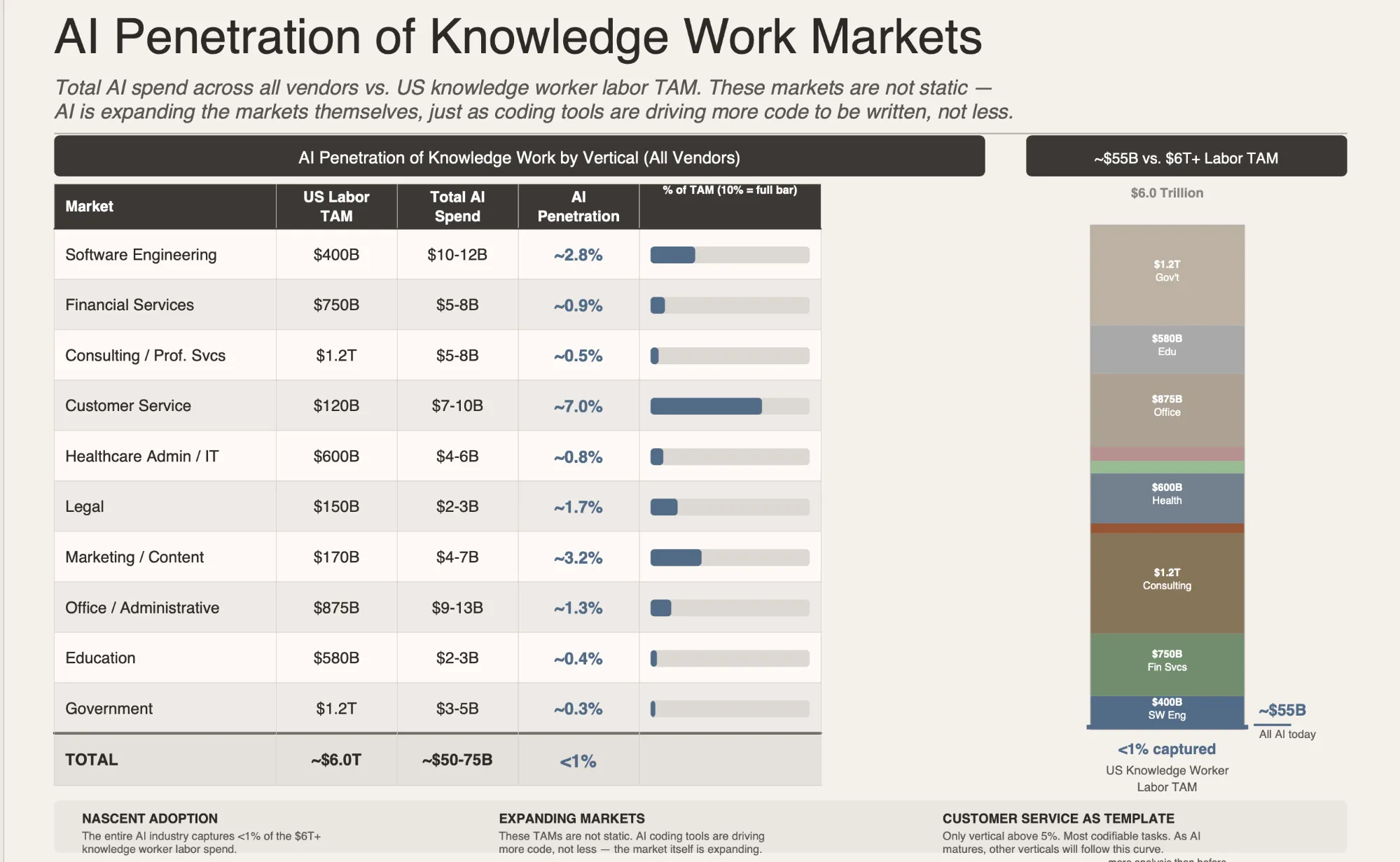
Customer service is the only vertical above 5%. Why? Because the tasks are the most codifiable and the ROI is the easiest to measure. It’s the template for what other verticals will eventually look like. I believe though the customer service market itself will grow quickly, because we can now provide better, more personal, higher quality customer service to all customers. Taking that expansion into account, we might not even be at 5% in this segment today.
Software engineering is at roughly 3%. This is supposed to be AI’s strongest wedge — Claude Code, GitHub Copilot, Cursor are all scaling fast. And yet, 97% of the $400B in developer labor spend is untouched.
The biggest labor pools are barely touched. Government ($1.2T), consulting ($1.2T), and office/administrative ($875B) are all under 1%. Combined, these three verticals represent over $3 trillion in labor spend with essentially sub 0.5% AI penetration. These aren’t product problems - they’re distribution and change management problems that will take years to unlock as AI diffuses through the economy.
But here’s what I think most people get wrong about this chart: these TAMs are not static.
The assumption behind most market sizing is that AI captures a slice of a fixed labor cost pie. I don’t think that’s right. We’re seeing the opposite in coding — AI tools are causing organizations to write more code, not less. The total volume of code being produced is exploding because the cost of producing it has dropped dramatically.
The same thing will happen in other verticals. When legal research takes minutes instead of weeks, firms will do more research. When financial analysis is cheap, companies will analyze more scenarios. When content creation is fast, organizations will produce more content.
AI isn’t just capturing existing labor spend — it’s expanding the markets themselves.
That’s why I think the <1% penetration number, striking as it is, actually understates the opportunity. The denominator is growing alongside the numerator.
If you think AI is big now, you haven’t done the math yet!
This post is also on Substack, where you can comment.