
Four Shifts Making Cybersecurity an AI Enabler
For more than 15 years, cybersecurity has been a board-level concern. Budgets grew year after year as the digital footprint of every company expanded. That hasn’t changed.
What has changed is the pace of disruption. The ground is shifting under our feet faster than ever before. And if you’re leading security or IT today, you are staring at the single biggest transformation our industry has ever seen.
Cybersecurity spend will continue to grow faster than overall IT spend — because digital value is business value. That connection is about to tighten dramatically as four fundamental shifts play out in parallel. These changes are in Revenue, Intelligent Apps, Smart Agents, and Killer adversaries (captured by the acronym R.I.S.K)
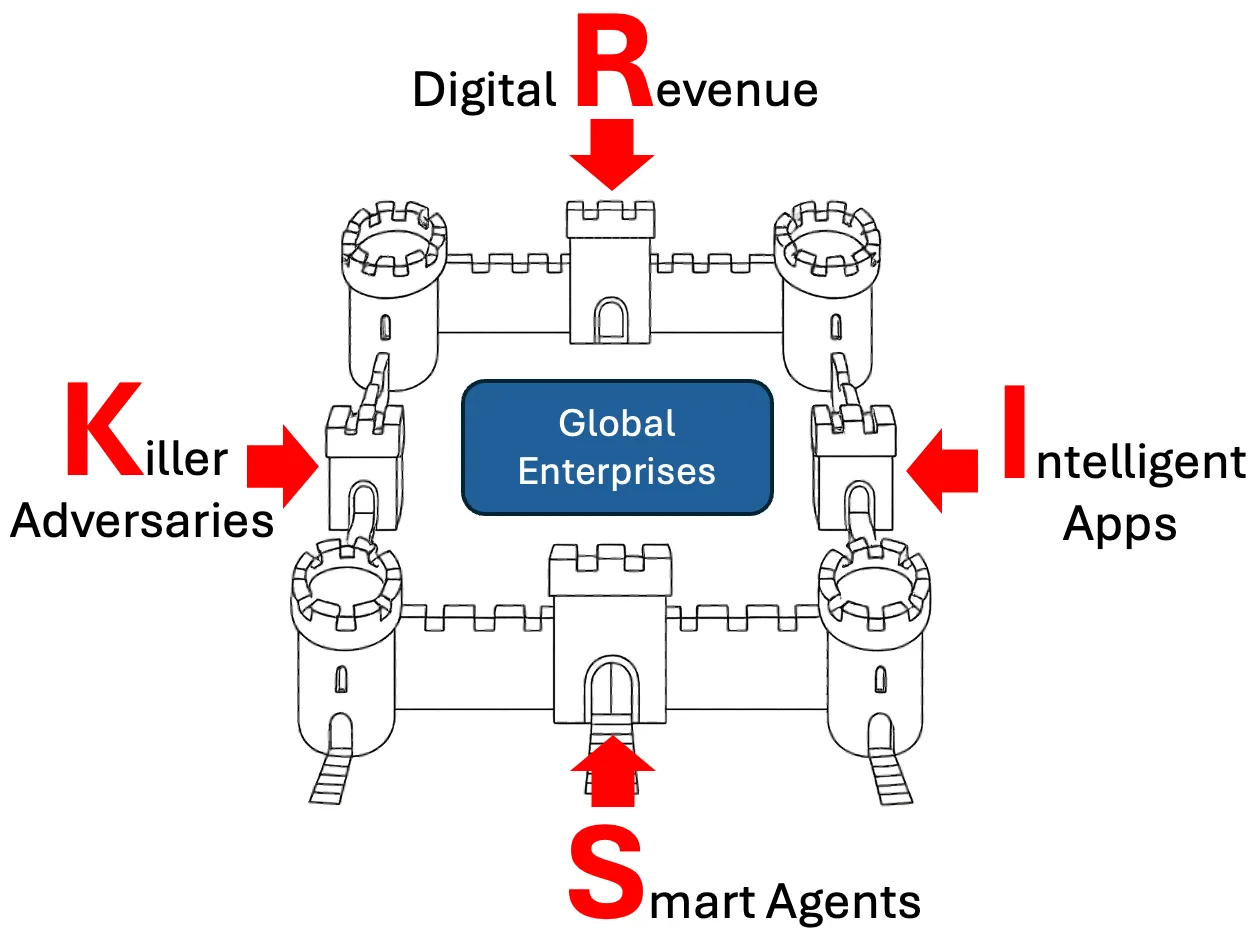
The first shift is economic - more Revenue will be digital.
Twenty-five years ago, technology represented just 3% of global GDP. Today it stands at 10%. With the acceleration of AI, it is on track to reach 20% within a decade. Every business will soon be a tech-first business, with both digital and human employees. AI will be central to competitiveness. As more of a company’s value becomes digital, the imperative to secure it becomes existential. Cybersecurity is no longer a back-office function — it is directly tied to revenue.
The second shift is architectural - Applications will be Intelligent.
Applications are moving from deterministic systems to probabilistic, AI-native ones. The difference is like going from buying a dishwasher, where you know exactly what will happen when you push a button, to bringing in a humanoid to wash your dishes. The intended outcome is the same, but the variability, range of behaviors, and risks are entirely different. Today’s application security tools were not built for this new reality, and we must rethink how we secure intelligent applications.
The third shift is operational - Smart Agents will Automate the Enterprise.
Enterprises are no longer simply deploying traditional software packages and managing user access. They are adopting AI systems — Claude, ChatGPT, Gemini, and others — that act, remember, and adapt. These systems function more like digital colleagues than static tools. The challenge is not only controlling access, but also understanding the capabilities and risks of these agents and establishing new guardrails to harness their power safely.
The fourth shift is adversarial - Adversaries are already AI-native.
Cybersecurity is the only technology domain with an active, adaptive opponent. And adversaries are already adopting AI. We are seeing phishing campaigns generated at scale, automated penetration testing of infrastructure and applications, and attacks that are more sophisticated, more scalable, and more impactful than ever before. The bad actors are getting faster, which means defenders must as well.
Cybersecurity Enables AI-Native Growth
These four forces — economic, architectural, operational, and adversarial — are converging at once. Together, they make clear that cybersecurity is not just a cost of doing business. It is a growth enabler. The ability to safely deploy AI, to scale new applications, and to build lasting trust with customers will depend entirely on how well organizations secure what they build.
In a world where applications are intelligent, adversaries are intelligent, and employees are both digital and human, it’s time for our security stack to be intelligent too! The good news is, founders are energized by this mission and companies such as Anthropic, Cyera, Chainguard, Descope, Litt, Clutch, Virtue, and many others are building the platforms that are already helping enterprises adopt and build with AI prioritizing safety, security, and trust.
Excited to see this evolution of cyber over the next decade!
This post is also on Substack, where you can comment.