
Could AI Have Been Einstein?

At a recent talk, a founder of a leading AI lab raised a question that stayed with me: how much of AI’s progress comes from exploring possibilities faster, and how much comes from imagining possibilities we would never have thought to explore?
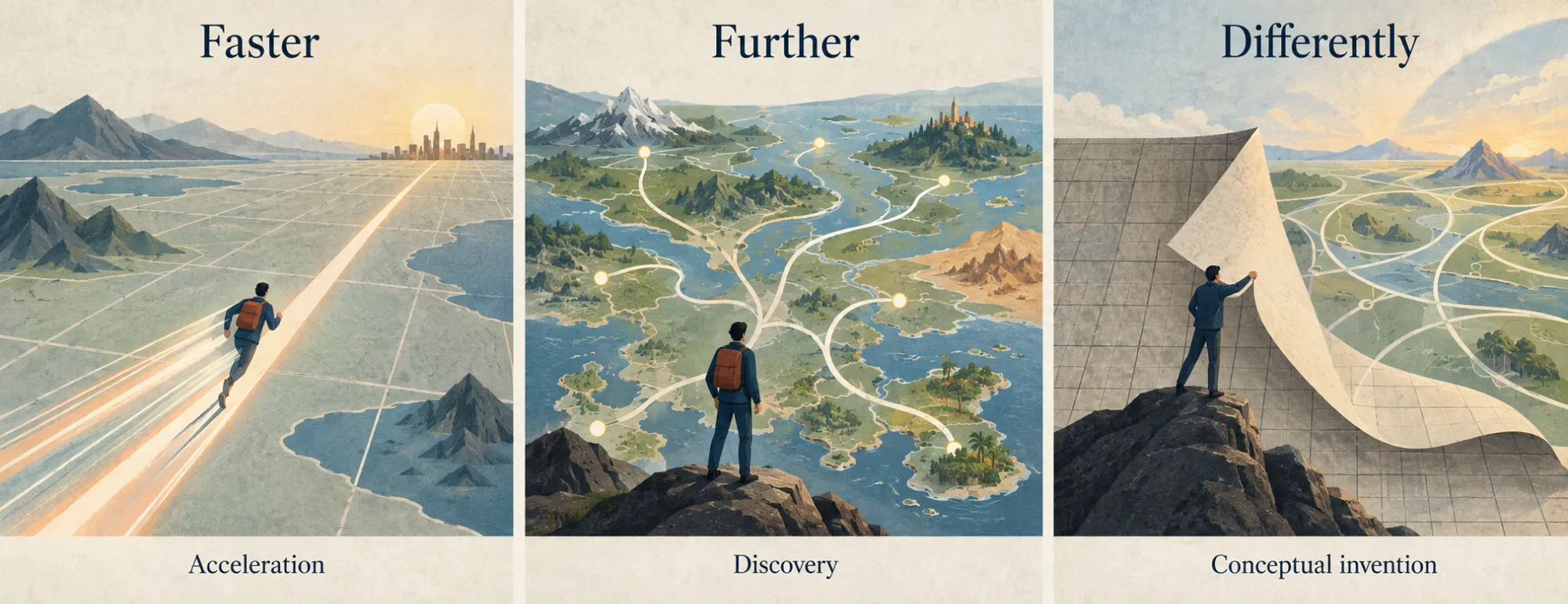
That distinction matters because there are several frontiers in AI development. Progress on one does not automatically mean we have conquered the others.
The first is acceleration. Writing software, testing approaches, and working through mathematical problems can all become faster when machines take on more of the work. A system that explores many promising paths in parallel can make projects practical that once demanded prohibitive amounts of human effort.
The second is discovery. Here, AI is already doing more than reproducing known answers. DeepMind’s AlphaEvolve combines language models with evolutionary search and automated evaluation to find improved algorithms and mathematical constructions. Some results surpass previously known solutions. Calling that merely imitation understates the achievement. Google DeepMind
But there is a further frontier: conceptual invention.
The cognitive scientist Margaret Boden distinguished between combining familiar ideas, exploring an existing conceptual space, and transforming that space. All three can be creative. The last is especially relevant to scientific revolutions: changing the assumptions that determine which explanations we even consider. Margaret Boden
This is where the Einstein thought experiment becomes compelling. Suppose we trained an AI using only knowledge available before relativity. Could it develop the theory itself? Demis Hassabis has posed essentially this question as a test of the kind of invention he wants AI to achieve. Possible interview
The challenge would extend beyond manipulating equations. Could the system recognize which assumptions deserved to be questioned, propose a different account of the world, and derive predictions that could prove it wrong?
A recent paper by Michael Shalyt and colleagues argues that this ability to formulate questions and invent guiding principles remains a critical gap in AI for physics. Accurate prediction and explanatory understanding are related achievements, but one does not establish the other. “Can AI Follow in Einstein’s Footsteps?”
We should be careful, however, about declaring that more search could never produce such a leap. Search can generate novelty. Human creativity also builds on existing knowledge. And a model’s training data is not simply a catalogue of every answer it could ever produce. Whether new conceptual frameworks can emerge from scaled learning, search, and experimentation is precisely the question still to be settled.
Even the Einstein test needs care. Asking a modern model to pretend it knows only nineteenth-century physics proves little. A meaningful experiment would need to prevent later knowledge from entering through training, tools, or helpful prompts. Failure by one historically trained model would not establish an inherent limit on AI.
My view is that acceleration, discovery, and conceptual invention deserve separate attention. We already have meaningful evidence of the first two. Reliable, autonomous scientific reframing remains a higher bar.
Accelerating humanity’s work would itself be an extraordinary achievement. The further ambition is an AI that can help us recognize when the questions we are asking—and the assumptions beneath them—need to change.
This post is also on Substack, where you can comment.