
Anthropic Then and Now: Revisiting My Interview with Daniela Amodei
In fall 2024, I interviewed Anthropic co-founder Daniela Amodei at Lightspeed’s San Francisco office. We discussed building frontier models, finding enterprise customers, and making safety part of the company’s approach to AI development.
Nearly two years later, Anthropic’s business and product range have expanded. In April 2026, the company reported that more than 1,000 business customers were each spending over $1 million on an annualized basis. Claude Code, which became generally available in May 2025, illustrates its move into tools that perform work directly. Revisiting our conversation offers a way to examine which priorities endured and how its approach changed.
Below, I revisit the nine questions from Lightspeed’s December 11, 2024 write-up, followed by my reflections today. The questions and Daniela’s answers are paraphrased; they describe her views at the time.
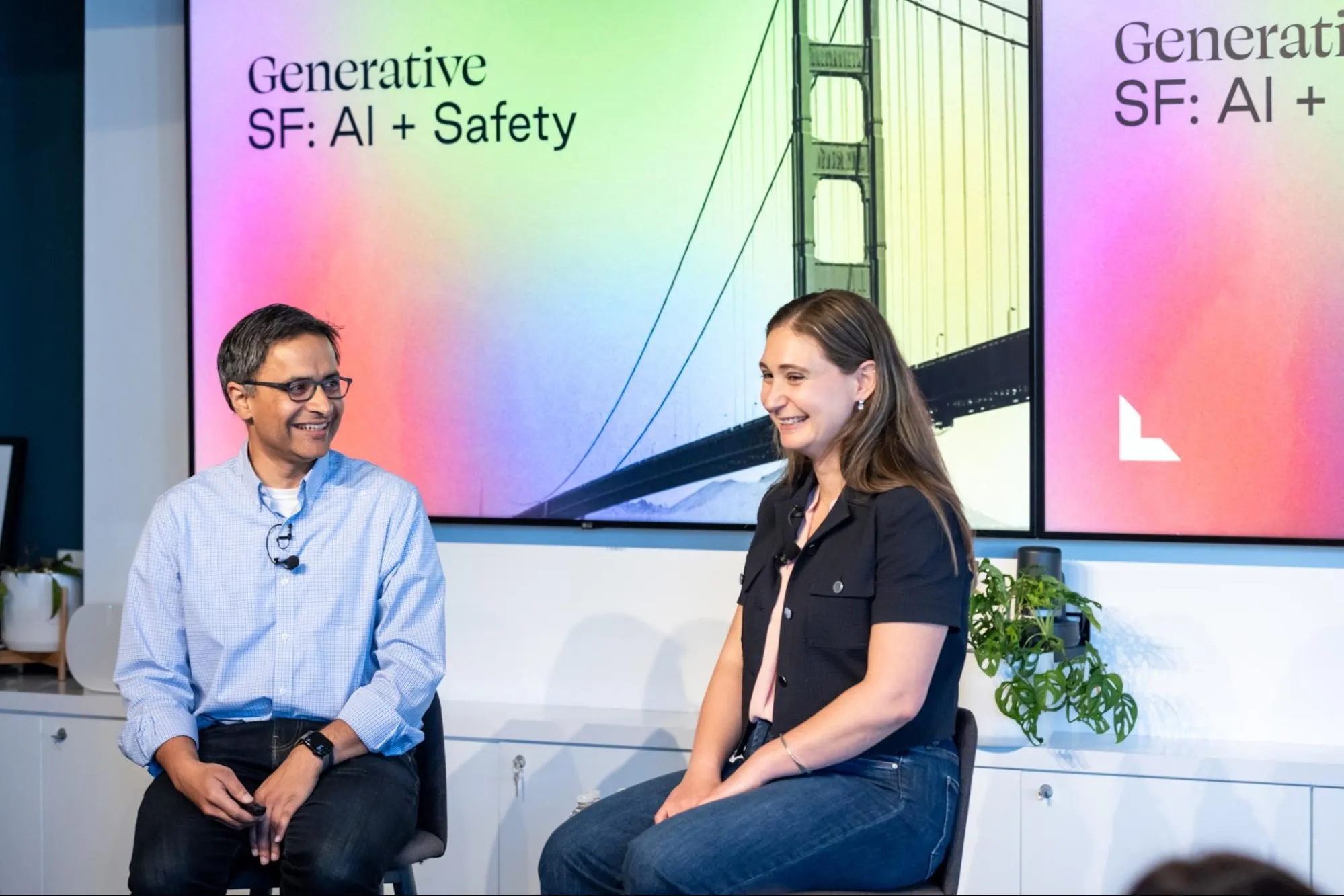
Guru Chahal (left) and Daniela Amodei at Lightspeed’s Generative SF event in 2024. Photo source: Lightspeed Venture Partners.
Revisiting the conversation
Why start Anthropic?
Daniela said she, Dario, and their five fellow co-founders expected AI to become transformative and wanted to develop powerful models that were trustworthy, reliable, and safe. She described the company’s work as balancing frontier research with customer needs. Those were the founding team’s ambitions, rather than a claim that the underlying technical problems had been solved.
How did she and Dario divide the work?
Daniela attributed their working relationship to complementary responsibilities. Dario, whose background was in physics, concentrated on the technical vision and research team. Daniela, whose background was in international development, focused on building the organization, hiring its leadership, and managing growth. She said their distinct strengths allowed each to take ownership of a different part of the company.
Could responsible development be a competitive advantage?
Daniela pointed to Anthropic’s public benefit corporation structure, policy expertise within the founding team, and work on Constitutional AI before launching a product. She identified three research questions: how to guide model behavior, understand its internal workings, and reduce harm from deployment. She also said Anthropic had worked with policymakers from the beginning. In her account, some enterprises chose Anthropic because of its attention to safety; safeguards could help customers adopt the technology.
Why were there so few companies building frontier models?
Her answer centered on capital and specialized talent. A company needed both, and access to one did not guarantee the other. Daniela said roughly two-thirds of Anthropic’s first fifteen employees had physics PhDs. The company had developed a recruiting and training approach that helped strong quantitative thinkers move into machine learning research.
What helped Anthropic attract that talent?
Daniela credited a stable, mission-focused working environment, opportunities to do frontier research, and growing product adoption. She also pointed to existing relationships: some early employees had worked together at OpenAI and Google. In her view, shared purpose and personal trust helped recruitment and collaboration.
What were people using Claude for?
Daniela highlighted coding, summarization, and content generation. She said Claude could outperform some of Anthropic’s engineers on narrow programming tasks. Summarization helped enterprises make sense of large volumes of structured and unstructured information, while writing assistance served functions such as sales, marketing, and HR. She expected usage to change as model capabilities improved.
Where did developers and startups fit?
Daniela described developers as a source of direct, rapid feedback that could take longer to obtain from large enterprises. At the time, she positioned Anthropic primarily as a builder of the underlying models. Its priority was improving Claude, with startups building applications and interfaces around it. That description captured the company’s product focus in 2024.
Why the name Claude?
With several prominent digital assistants carrying women’s names, Daniela wanted a male name. To her, Claude suggested an older, friendly, wise person who was there to help. She said users had responded to the model’s warmth and relatability, although Anthropic had not deliberately set out to create that exact personality.
How did she think about AGI?
Daniela focused on the practical implications of improving AI capabilities for people, businesses, and the economy. She noted that models could already exceed individual people at some tasks while still making errors, including hallucinations. Her hope was that further progress, accompanied by effective safeguards, would let people devote more time to creative work and less to routine tasks.
What changed—and what remains unresolved
Three points stand out to me when I compare those answers with Anthropic’s subsequent development.
First, its product scope expanded. Claude Code brought Anthropic directly into developers’ workflows. By May 2026, its financial-services offering included agent templates for pitchbooks, KYC screening, and month-end close. These releases show how its role has broadened since Daniela described a primary focus on underlying models. For founders building on Claude, that evolution makes product differentiation and ownership of the customer relationship more consequential.
Second, the relationship between safety and adoption deserves a precise reading. Daniela said safety influenced some customers’ decisions. Later growth figures show commercial adoption, but do not establish how much safety contributed to it. Assessing that connection would require customer evidence. I still see a practical reason to take it seriously: delegating consequential work requires confidence in how a system behaves, handles data, and responds to errors.
Third, Anthropic’s safety policies changed. Its February 2026 Responsible Scaling Policy revision separated its own plans from recommendations for the wider industry and introduced public safety roadmaps and recurring risk reports. The roadmap targets are explicitly nonbinding, with progress to be reported publicly. These measures provide a basis for scrutiny; their publication alone does not establish that safeguards are effective.
Looking back, I see continuity in Anthropic’s stated priorities: advancing model capabilities, serving customers, and addressing safety. Its products and policies have evolved as the business has grown. The question raised by our conversation remains open: how well can those priorities be delivered together as AI takes on more consequential work?
Read the original Lightspeed interview.
Sources
Lightspeed: Generative SF: How Anthropic is building better, safer AI models — December 11, 2024.
Anthropic: Google and Broadcom compute partnership — April 6, 2026.
Anthropic: Introducing Claude 4 and general availability of Claude Code — May 22, 2025.
Anthropic: Agents for financial services — May 5, 2026.
Anthropic: Responsible Scaling Policy Version 3.0 — February 24, 2026.
This post is also on Substack, where you can comment.