
AI's Next Frontier: Learning from Experience
Lessons from David Silver and Lasse Espeholt on building a superlearner
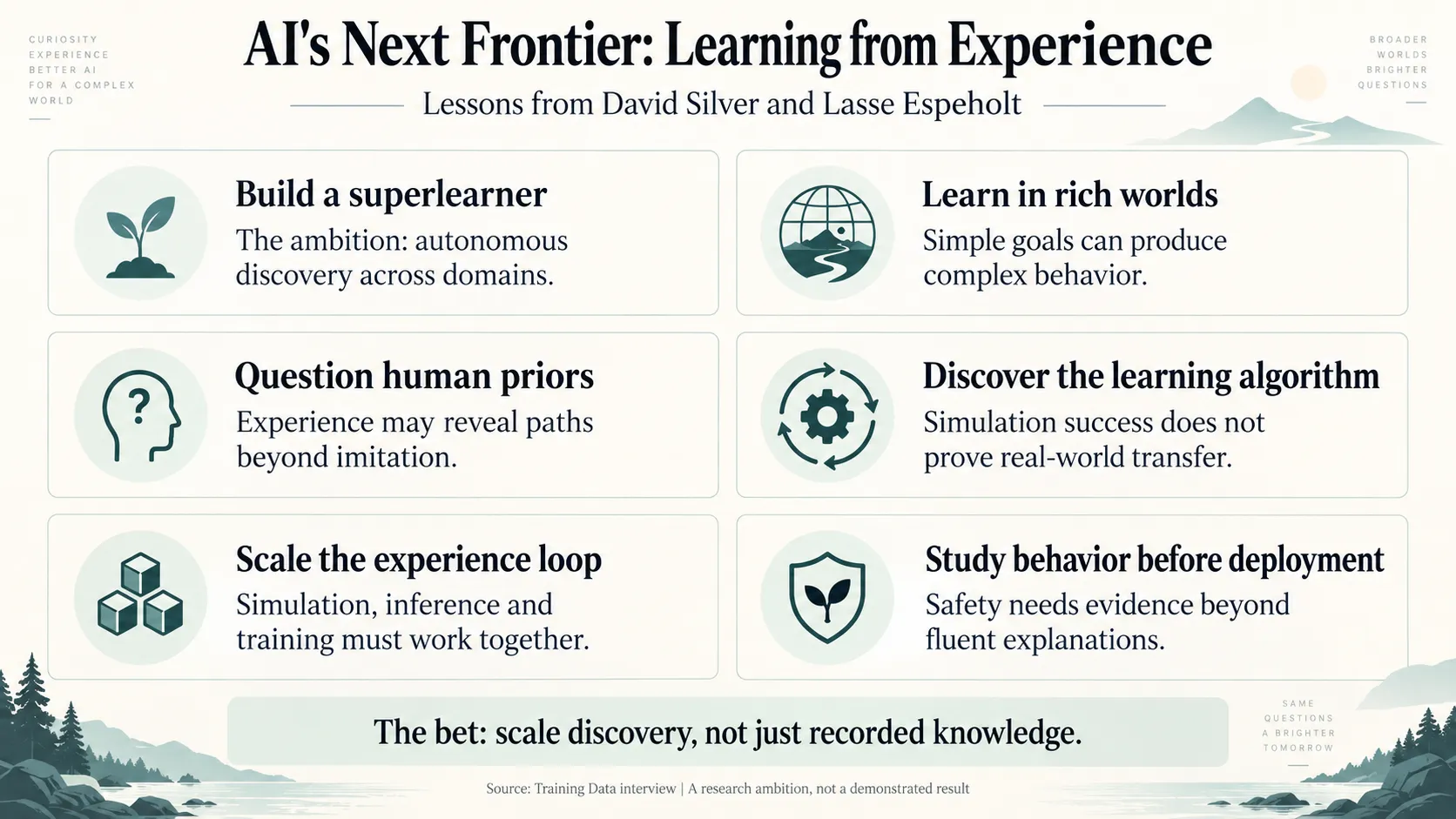
I recently listened to a fascinating Training Data conversation with David Silver and Lasse Espeholt, co-founders of Ineffable Intelligence.
What stood out was the ambition to build AI that discovers knowledge for itself, through experience, rather than depending on the knowledge humans have already recorded.
Silver has spent much of his career pursuing that idea through reinforcement learning, including the work behind AlphaGo and AlphaZero. Espeholt brings deep experience in the engineering required to scale reinforcement learning.
Their new company is making a substantial research bet: that a sufficiently capable learning algorithm, placed in sufficiently rich environments, can keep discovering things that its designers did not anticipate.
Here are the ideas that stood out to me.
1. The goal is a superlearner, not simply a more knowledgeable model
Silver describes a superlearner along two dimensions: depth and breadth.
Depth means the ability to start with little knowledge and eventually discover things beyond what humans know. Breadth means the ability to learn across different streams of experience, whether simulated, digital, or physical.
The ambition goes beyond solving a difficult problem once. It is to build a system that can keep learning, adapting, and generating new knowledge across domains.
That distinction matters.
A model may produce a valuable scientific result without demonstrating that it can autonomously sustain the entire process of discovery. Silver argues that much of today’s progress still depends on people choosing problems, designing training stages, and guiding the learning process.
He is respectful of what language models have accomplished. His question is whether the current approach will produce the general capacity to discover that he has in mind.
For me, this changes the way we should evaluate the ambition. The relevant test is whether the system can keep finding useful things to learn when the next lesson has not been specified by a human.
2. Simple goals can produce surprisingly complex behavior
One of the most interesting parts of the conversation was Silver’s argument about reward design.
A common approach is to define a specific task, reward the desired answer, and then move the agent through a sequence of increasingly difficult tasks.
Ineffable is exploring a different approach: give agents relatively simple objectives in environments with enough complexity that useful capabilities can emerge along the way.
Silver uses human development as an analogy. In pursuing relatively basic goals, people learned to coordinate, communicate, trade, use tools, and develop increasingly sophisticated mathematics and science.
The objectives did not explicitly specify every capability that eventually appeared.
Similarly, an agent might discover that communication or a new tool helps it achieve a goal, even if its reward function never directly asked it to invent a language or build that tool.
This is a compelling research hypothesis. It also places a great deal of weight on the environment: a simple objective in an uninteresting world may produce very little.
The challenge is creating conditions where discovering something new continues to be useful.
3. The learning environment becomes part of the invention
Ineffable calls its simulated learning environments crucibles.
These are intended to support emergent complexity, rather than function only as collections of handcrafted puzzles with known solutions.
That complexity can come from interacting objects, physics, or multiple agents whose behavior changes as they learn.
Silver’s example is Go. The rules are relatively simple, but an opponent creates a much richer problem because each player must respond to the possible strategies of the other.
The broader point is that complexity does not always require a highly detailed simulation of the physical world. It can also arise from the interaction of learners.
Espeholt emphasizes the importance of building a range of environments, including simpler ones that run quickly and allow the team to iterate.
For founders, this suggests an interesting shift in where technical value may sit. The learning algorithm matters, but so do the worlds, feedback signals, and interactions that allow it to improve.
An environment is useful when it keeps generating meaningful learning opportunities. Its value is not captured by how realistic it looks.
4. Giving up human data is a deliberate research tradeoff
Silver is making a conscious choice to move away from reliance on massive datasets of human knowledge.
His concern is that those datasets can make it harder to discover learning algorithms that work beyond the domains and representations humans already understand.
The inspiration comes partly from the progression from AlphaGo to systems that learned through self-play without human game examples.
Those results showed that, in specific games, learning from experience could produce strategies and performance beyond the human examples available to the system.
But there is an important limit to the analogy. A game provides clear rules and a clear outcome. Open-ended discovery across science, technology, and the physical world is a much broader challenge.
Silver also makes clear that this is a pragmatic choice. Human-designed environments and reward functions still introduce assumptions. Ineffable is not claiming to eliminate every human prior.
The bet is that relying less on accumulated human answers will force the team to solve more of the underlying learning problem, even if doing so sacrifices performance in the near term.
That is an ambitious tradeoff. The success of self-play in games gives it a foundation, but does not establish that the same approach will produce a general superlearner.
5. Discovering in simulation and transferring to the real world are different problems
Silver sees simulation as a powerful place to develop and study these systems.
Simulated experiments can run in parallel, be reproduced, and allow agents to gain experience much faster than many physical experiments would permit.
A simulated world can also support rich forms of computation and interaction without reproducing every detail of reality.
But both researchers acknowledge limits. A system can learn about the rules of its simulated world without acquiring knowledge that transfers directly to ours.
Silver makes a useful distinction here: discovering a general learning algorithm in simulation is different from expecting every skill or fact learned there to work in the real world.
The hope is that the learning process itself can later operate on real experience, with increasingly realistic simulations providing additional tests along the way.
For me, this is one of the most important distinctions in the interview. Impressive behavior in a simulated environment is evidence about that environment. The broader claim still needs evidence that the learner can adapt when the world changes.
6. Scaling experience requires a different compute stack
Espeholt separates the workload into three parts: simulation, inference, and training.
The agent needs to experience an environment, choose actions, and learn from the results. Those activities form a repeated loop, and the economics depend on how efficiently the whole loop runs.
He describes the team’s effort to run simulation alongside inference and training on GPUs, avoiding a design that requires enormous amounts of separate CPU capacity.
He also notes that GPUs have been shaped heavily by training and inference workloads. Simulation has different requirements, so making these environments run efficiently requires substantial engineering.
The scaling question is more complicated than feeding more examples from a fixed dataset into a model.
As a reinforcement learning agent improves, its behavior changes. That changes the experience it generates, which changes the data from which it learns. In a multi-agent environment, other learners can change at the same time.
Espeholt describes scaling laws for this setting as an active research direction. The interview does not establish a dependable formula connecting more compute to general intelligence.
The infrastructure implication is clear: simulation speed, data reuse, accelerator utilization, and the coordination of the learning loop could all become important sources of advantage.
7. Safety needs evidence about behavior, not just explanations
The conversation also raises an important question: how do we understand a powerful learner that may not reason in human language?
Silver argues that monitoring an agent’s verbal explanations will become increasingly insufficient as systems become more capable.
He proposes studying how powerful agents interact in simulation, including the conditions under which they cooperate and coexist with less capable agents.
He also discusses possible approaches such as observing proposed actions before allowing them to affect the world, and using other capable systems as monitors.
These are research directions, rather than demonstrated solutions to alignment.
Silver says Ineffable intends to gate real-world progress on sufficient evidence from this research. His view is that experiments in simulation should move quickly while deployment into the real world should proceed carefully.
I found that distinction useful. A contained experiment can help answer questions about behavior, but successful learning in simulation is not itself proof that deployment will be safe.
What this means for AI
Three broader observations stood out to me.
First, experience could become a major source of new training data. The quality of the feedback loop matters: what the agent can try, what it can observe, and how reliably it can learn from the outcome.
Second, learning environments may become an important part of the AI stack. Better models will need better places to experiment, interact, and discover. That creates interesting questions for simulation, evaluation, and infrastructure companies.
Third, the ability to discover is a different capability from the possession of knowledge. The most consequential systems may be those that can keep improving when their designers no longer know the answers.
Silver offers an aggressive forecast: strong evidence for the approach within a year of the interview, and a system meeting his definition of superintelligence in roughly three years. Those are his expectations, with acknowledged uncertainty, rather than results the company has already demonstrated.
For me, the biggest takeaway is the research question underneath that forecast: can we build a learner that keeps discovering useful knowledge without a human designing each next step?
If that works across domains, it could change how AI capabilities are built, where infrastructure investment goes, and what we need to measure before putting those systems into the world.
This post is also on Substack, where you can comment.