
AI as Its Own Teacher?
When Models Train Themselves Without Human Data
I’m a bit late to this paper - https://arxiv.org/pdf/2505.03335 - but found it fascinating given the broad interest in how RL can be scaled both within scoped domains and outside of them.
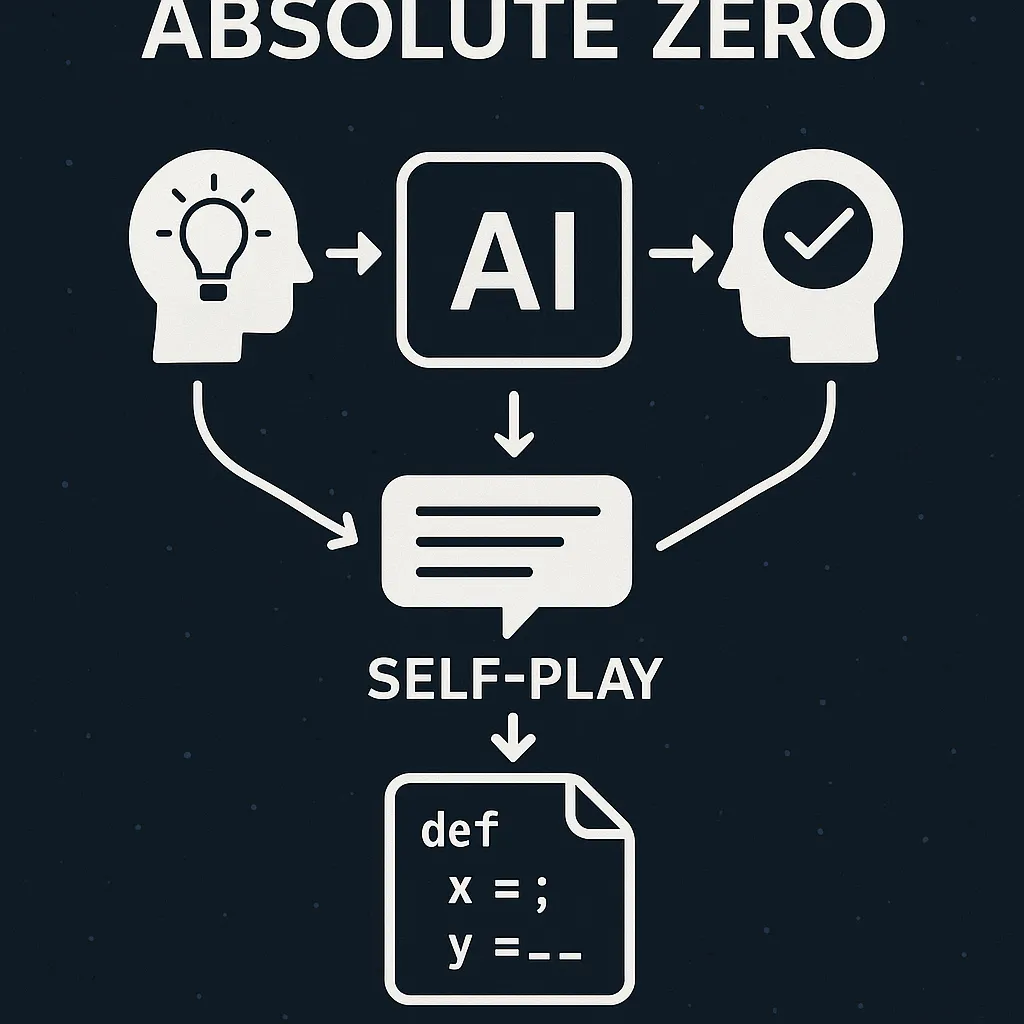
The paper proposes “Absolute Zero” - a revolutionary training paradigm where AI models learn reasoning capabilities entirely through self-play, without using ANY human-curated data or examples. The model simultaneously learns to:
-
Propose tasks that maximize its own learning potential
-
Solve those tasks to improve its reasoning abilities
What’s Novel and Different
Key Innovation: Complete Independence from Human Data
Unlike existing “zero” setting models (like DeepSeek-R1) that still rely on tens of thousands of human-curated question-answer pairs, Absolute Zero eliminates ALL dependency on external data. Here’s what makes it unique:
1. Self-Generated Learning Curriculum
-
The model autonomously creates its own training tasks optimized for learnability
-
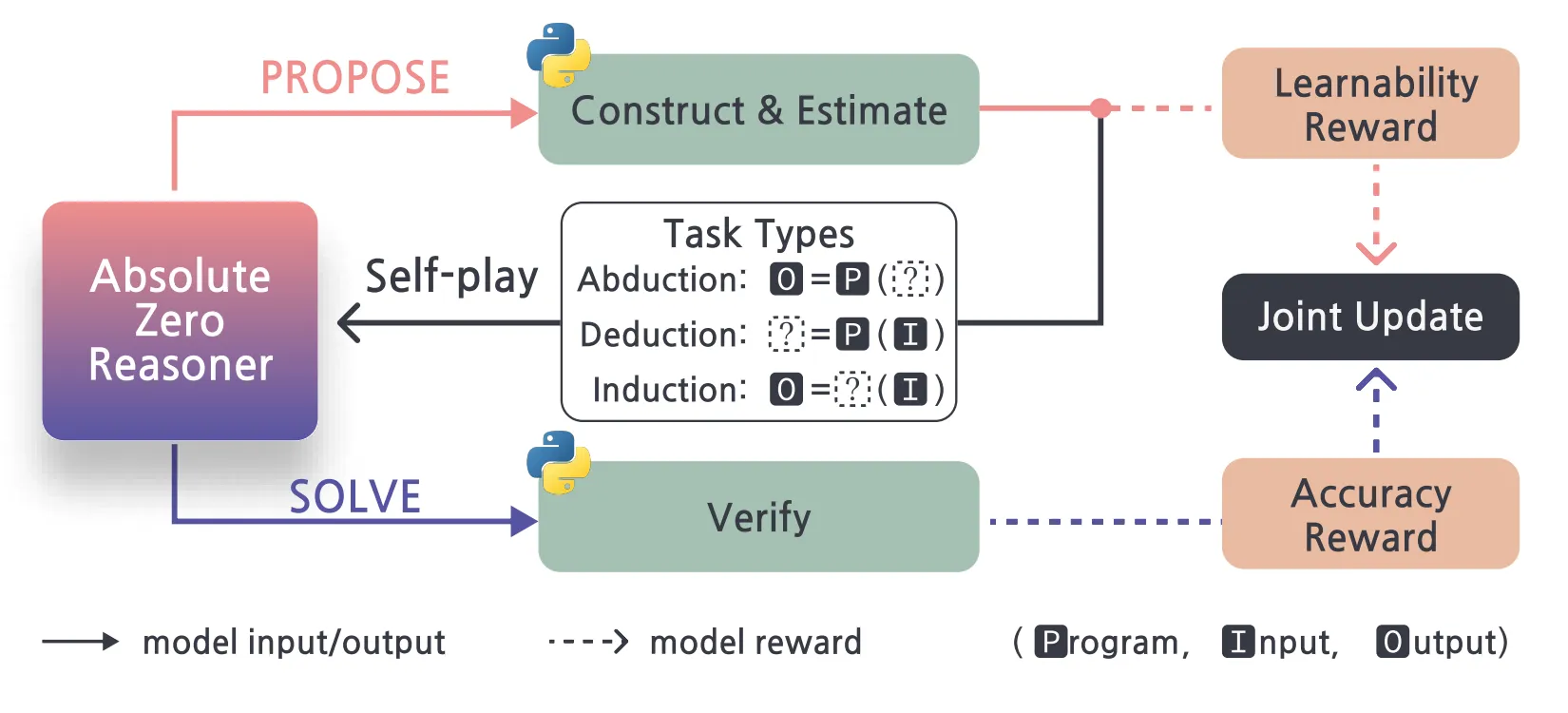
Uses a “learnability reward” that favors tasks of moderate difficulty (not too easy, not impossible)
-
Dynamically evolves the task distribution based on its current capabilities
2. Unified Proposer-Solver Architecture
-
A single model plays both roles rather than separate agents
-
The proposer generates coding tasks conditioned on past examples
-
The solver attempts to solve these self-generated tasks
-
Both roles are trained jointly through reinforcement learning
3. Three Complementary Reasoning Modes
-
Deduction: Predict output given program and input (step-by-step logical reasoning)
-
Abduction: Infer input given program and output (trial-and-error reasoning)
-
Induction: Synthesize program from input-output examples (generalization from patterns)
4. Code Executor as Grounded Environment
-
Uses Python code execution as a verifiable, open-ended environment
-
Provides reliable feedback without learned reward models (avoiding reward hacking)
-
Ensures tasks are valid and solutions are verifiable
Remarkable Results
Despite never seeing human-curated data:
-
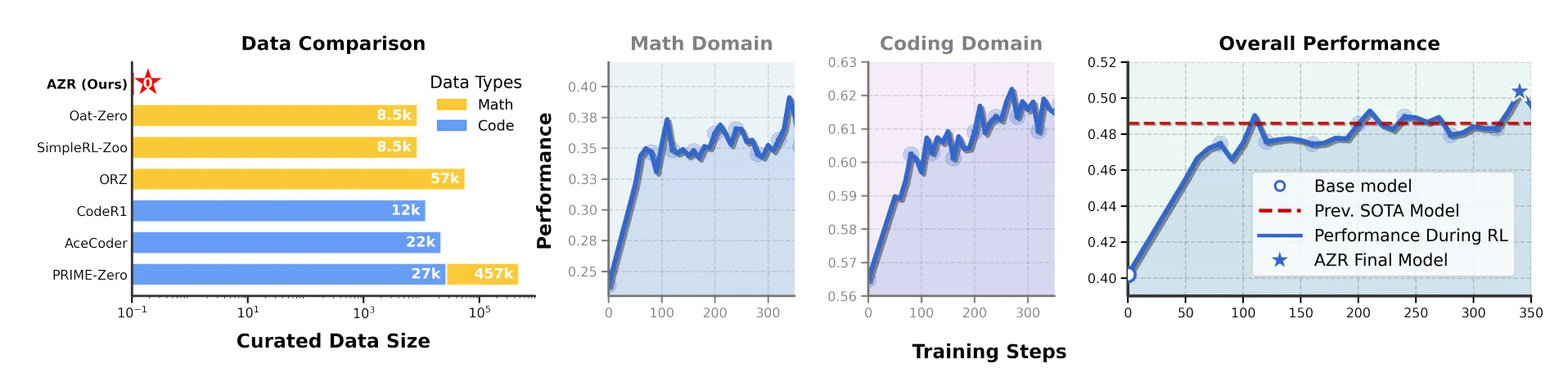
Achieves state-of-the-art performance on both coding and math benchmarks
-
Outperforms models trained on 22,000-484,000 human examples by 1.8% on average
-
Shows stronger cross-domain generalization than models trained on domain-specific data
-
Demonstrates that general reasoning skills can emerge without any human supervision
Key Insight
The paper demonstrates that AI systems can potentially achieve superhuman reasoning by learning from self-generated experience rather than being constrained by human-provided examples. They start with just a single trivial “seed” program (an identity function) and bootstrap from there entirely through self-play.
The success of Absolute Zero suggests that self-generated curricula might be a viable path forward as we approach the limits of available human-generated training data.
Having said that, the paper is old, from June, so I’m sure either these techniques have already been incorporated into the latest models - or disproven for real world model training. Either way, the paper was a great read!
This post is also on Substack, where you can comment.